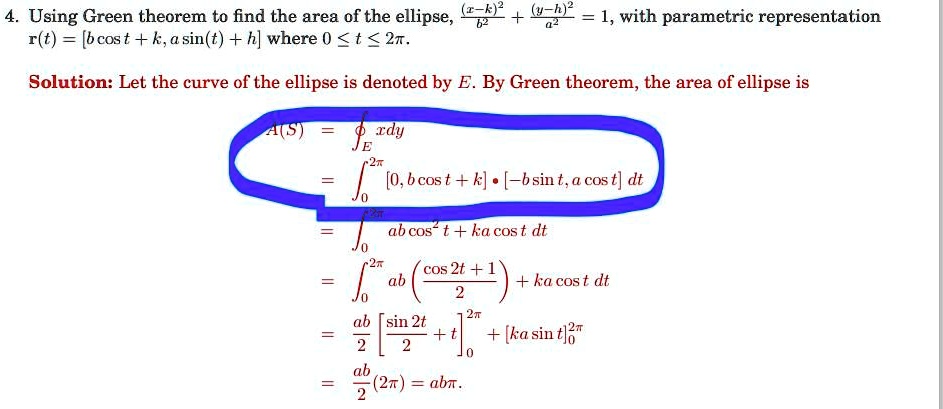
4. Using Green theorem to find the area of the ellipse, $\frac{(x-k)^2}{b^2} + \frac{(y-h)^2}{a^2} = 1$, with parametric representation
$r(t) = [b \cos t + k, a \sin(t) + h]$ where $0 \le t \le 2\pi$.
Solution: Let the curve of the ellipse is denoted by E. By Green theorem, the area of ellipse is
$A(S) = \oint_E x \, dy$
$= \int_0^{2\pi} [0, b \cos t + k] \cdot [-b \sin t, a \cos t] \, dt$
$= \int_0^{2\pi} ab \cos^2 t + ka \cos t \, dt$
$= \int_0^{2\pi} ab \left(\frac{\cos 2t + 1}{2}\right) + ka \cos t \, dt$
$= \frac{ab}{2} \left[\frac{\sin 2t}{2} + t\right]_0^{2\pi} + [ka \sin t]_0^{2\pi}$
$= \frac{ab}{2} (2\pi) = ab\pi.$