Ace - AI Tutor
Ask Our Educators
Textbooks
My Library
Flashcards
Scribe - AI Notes
Notes & Exams
Download App
devin leon

devin l.

Divider

Questions asked

BEST MATCH

The gearshift lever AB for the transmission of a sports car has position vector $\vec{r}$ whose line of action passes through points A and B. The driver applies a force $\vec{F}$ to the knob of the lever to shift gears. If the component of $\vec{F}$ perpendicular to the gearshift lever must be 5.5 N to shift gears, determine the magnitude F of the force. (Round the final answer to four decimal places.) $\vec{r} = (-5\vec{i} + 2\vec{j} + 14\vec{k})$ mm $\vec{F} = F(\frac{1}{11})(9\vec{i} - 6\vec{j} - 2\vec{k})$ The magnitude F of the force is [ ] N.

View Answer
divider
BEST MATCH

Questions Analyze the trends and patterns of unemployment rates in Canada over the past decades. What factors have contributed to fluctuations in the unemployment rate during the period? Assess the impact of technological advancements and automation on unemployment levels in Canada. How is the labor market adapting to technological changes, and what measures can be taken to mitigate the negative effects of automation on employment? automation on employment? 2. Assess the impact of technological advancements and during the period? measures can be taken to mitigate the negative effects of labor market adapting to technological changes, and what automation on unemployment levels in Canada. How is the contributed to fluctuations in the unemployment rate Canada over the past decades. What factors have 1. Analyze the trends and patterns of unemployment rates in Questions

View Answer
divider
BEST MATCH

When perceiving an image, the brain uses _________ to work through all the information at the same time. The "information" is from nerve cells in the brain that respond to specific parts of stimulus (such as edges or lines), which is known as _________. Finally, the process known as _________ unites neural activity into a finalized image in the cerebral cortex.

View Answer
divider
BEST MATCH

Solve k^2 + 14 = 0 using complex numbers if necessary. k = Solve k^2 + 14 - 0 using complex numbers if necessary. k

View Answer
divider
BEST MATCH

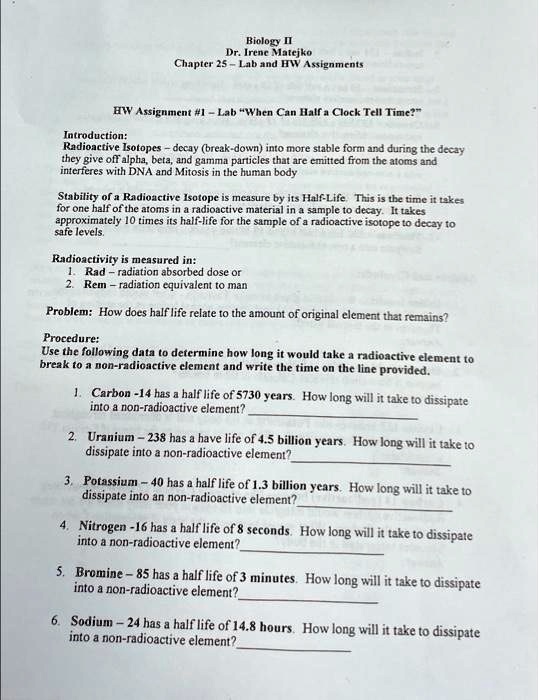
Biology II Dr. Irene Matejko Chapter 25- Lab and HW Assignments HW Assignment #1 - Lab "When Can Half a Clock Tell Time?" Introduction: Radioactive Isotopes - decay (break-down) into more stable form and during the decay they give off alpha, beta, and gamma particles that are emitted from the atoms and interferes with DNA and Mitosis in the human body Stability of a Radioactive Isotope is measure by its Half-Life. This is the time it takes for one half of the atoms in a radioactive material in a sample to decay. It takes approximately 10 times its half-life for the sample of a radioactive isotope to decay to 1-life for safe levels. Radioactivity is measured in: 1. Rad - radiation absorbed dose or 2. Rem - radiation equivalent to man Problem: How does half life relate to the amount of original element that remains? Procedure: Use the following data to determine how long it would take a radioactive element to break to a non-radioactive element and write the time on the line provided. 1. Carbon -14 has a half life of 5730 years. How long will it take to dissipate into a non-radioactive element? 2. Uranium - 238 has a have life of 4.5 billion years. How long will it take to dissipate into a non-radioactive element? 3. Potassium - 40 has a half life of 1.3 billion years. How long will it take to dissipate into an non-radioactive element? viles 4. Nitrogen -16 has a half life of 8 seconds. How long will it take to dissipate into a non-radioactive element? 5. Bromine-85 has a half life of 3 minutes. How long will it take to dissipate into a non-radioactive element? 6. Sodium-24 has a half life of 14.8 hours. How long will it take to dissipate into a non-radioactive element? Biology II Dr.Irene Matejko Chapter 25-Lab and HW Assignments HW Assignment #1-Lab When Can Half a Clock Tell Time? Introduction: Radioactive Isotopes -decay break-down into more stable form and during the decay they give off alpha, beta, and gamma particles that are emitted from the atoms and interferes with DNA and Mitosis in the human body Stability of a Radioactive Isotope is measure by its Half-Life This is the time it takes for one half of the atoms in a radioactive material in a sample to decay.It takes approximately 10 times its half-life for the sample of a radioactive isotope to decay to safe levels. Radioactivity is measured in 1.Rad-radiation absorbed dose or 2. Rem -radiation equivalent to man Problem: How does half life relate to the amount of original element that remains? Procedure: Use the following data to determine how long it would take a radioactive element to break to a non-radioactive clement and write the time on the line provided. i.Carbon -14 has a half life of 5730 years. How long will it take to dissipate into a non-radioactive element? 2 Uranium-238 has a have life of 4.5 billion years. How long will it take to dissipate into a non-radioactive element? 3.Potassium -40 has a half life of 1.3 billion years.How long will it take to dissipate into an non-radioactive element? 4.Nitrogen -16 has a half life of 8 seconds. How long will it take to dissipate into a non-radioactive element? 5.Bromine-85 has a half life of 3 minutes.How long will it take to dissipate into a non-radioactive element? 6.Sodium-24 has a half life of 14.8 hours.How long will it take to dissipate into a non-radioactive element?
View Answer
divider
BEST MATCH

There is a 0.9989 probability that a randomly selected 32-year-old male lives through the year. A life insurance company charges $145 for insuring that the male will live through the year. If the male does not survive the year, the policy pays out $90,000 as a death benefit. Complete parts (a) through (c) below. a. From the perspective of the 32-year-old male, what are the monetary values corresponding to the two events of surviving the year and not surviving? The value corresponding to surviving the year is $ The value corresponding to not surviving the year is $ (Type integers or decimals. Do not round.) b. If the 32-year-old male purchases the policy, what is his expected value? The expected value is $ (Round to the nearest cent as needed.) c. Can the insurance company expect to make a profit from many such policies? Why? because the insurance company expects to make an average profit of $ on every 32-year-old male it insures for 1 year. (Round to the nearest cent as needed.)

View Answer
divider
BEST MATCH

Estimate the error if $P_2(x) = 1 - \frac{x^2}{2}$ is used to estimate the value of cos x at x = 0.2. \text{Error} < 0.0000667 (Simplify your answer. Round to seven decimal places as needed.)

View Answer
divider
BEST MATCH

A particle of mass M is moving in the positive x direction with speed v. It spontaneously decays into 2 photons, with the original particle disappearing in the process. One photon has energy 233 MeV and moves in the positive x direction, and the other photon has energy 21 MeV and moves in the negative x direction. Find the mass M of the particle, in units of MeV/c2

View Answer
divider
BEST MATCH

Q#3 Let L = \{a^n b^n: 0 \le n \le 3\}. a) Show a regular expression for the given L. b) Show Finite Automata that accept given L.(Along with dead-end states properly)

View Answer
divider
BEST MATCH

24. Below is the data that was gathered from am experiment: grain diameter yield strength mm MPa 0.008 250 0.005 285 Using the Hall-Petch equation, determine the required grain diameter so the yield strength becomes 325 MPa. a. $2.65 \times 10^{-3}$ b. $2.98 \times 10^{-3}$ c. $3.26 \times 10^{-3}$ d. Answer is not among the choices 25. Aluminum oxide is used as an abrasive. What is the %IC of the interatomic bond for aluminum oxide? a. 70.2 b. 65.2 c. 59.4 d. Answer is not among the choices 26. What is the diffusion gradient if the diffusion coefficient is $6.5 \times 10^{-11}$ m²/s and the diffusion flux is $2.5 \times 10^{-9}$ kg/m²-s? a. 26.5 b. 38.5 c. 42.1 d. Answer is not among the choices. 27. Electronegativity of an element in the periodic table increases in moving from ____ a. Top to bottom b. Left to right c. Right to left d. Both a and b 28. Which microstructure of iron-carbon alloys is the hardest? a. Pearlite b. Bainite c. Martensite d. Tempered martensite

View Answer
divider