Don't work.
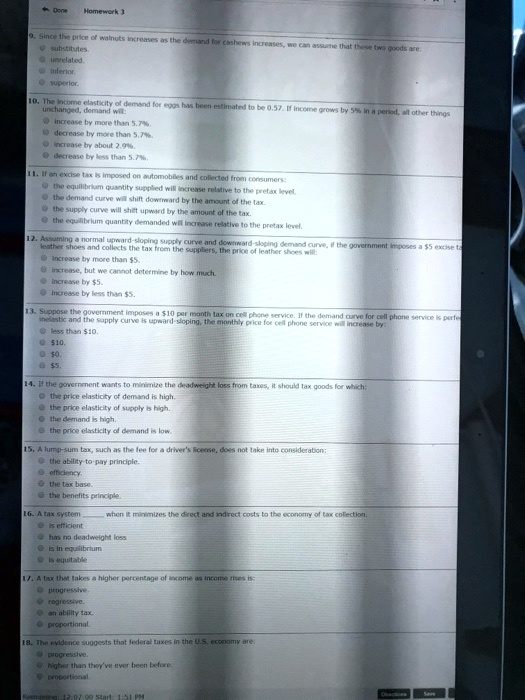
Since the price of substitutes is unrelated, inferior, or superior.
10. The income elasticity of demand is estimated to be 0.57. If income grows by 5% in a period, all other things will increase by more than 5.7%, decrease by more than 5.7%, increase by about 2.9%, or decrease by less than 5.7%.
If an excise tax is imposed on automobiles and collected from consumers at the equilibrium quantity supplied, it will increase relative to the pretax level. The demand curve will shift downward by the amount of the tax. The supply curve will shift upward by the amount of the tax. The equilibrium quantity demanded will increase relative to the pretax level.
2. Assuming a normal upward-sloping supply curve and downward-sloping demand curve, if the government imposes a $5 excise tax on leather shoes and collects the tax from the suppliers, the price of leather shoes will increase by more than $5, increase but we cannot determine the exact amount, or increase by $5.
14. If the government wants to minimize the deadweight loss from taxes, it should tax goods for which the price elasticity of demand is high, the price elasticity of supply is high, the demand is high, or the price elasticity of demand is low.
15. A lump-sum tax, such as the fee for a driver's license, does not take into consideration the ability-to-pay principle, the tax base, or the benefits principle.
16. A tax system is efficient when it minimizes the direct and indirect costs to the economy, has no deadweight loss, or is in equilibrium.
17. A tax that takes a higher proportion of income from higher-income individuals is a progressive tax, proportional tax, or regressive tax.
18. Federal taxes in the U.S. are progressive, proportional, or regressive.