Ace - AI Tutor
Ask Our Educators
Textbooks
My Library
Flashcards
Scribe - AI Notes
Notes & Exams
Download App
Diana Delos Santos

Diana D.

Divider

Questions asked

ANSWERED

Shu Naito verified

Numerade educator

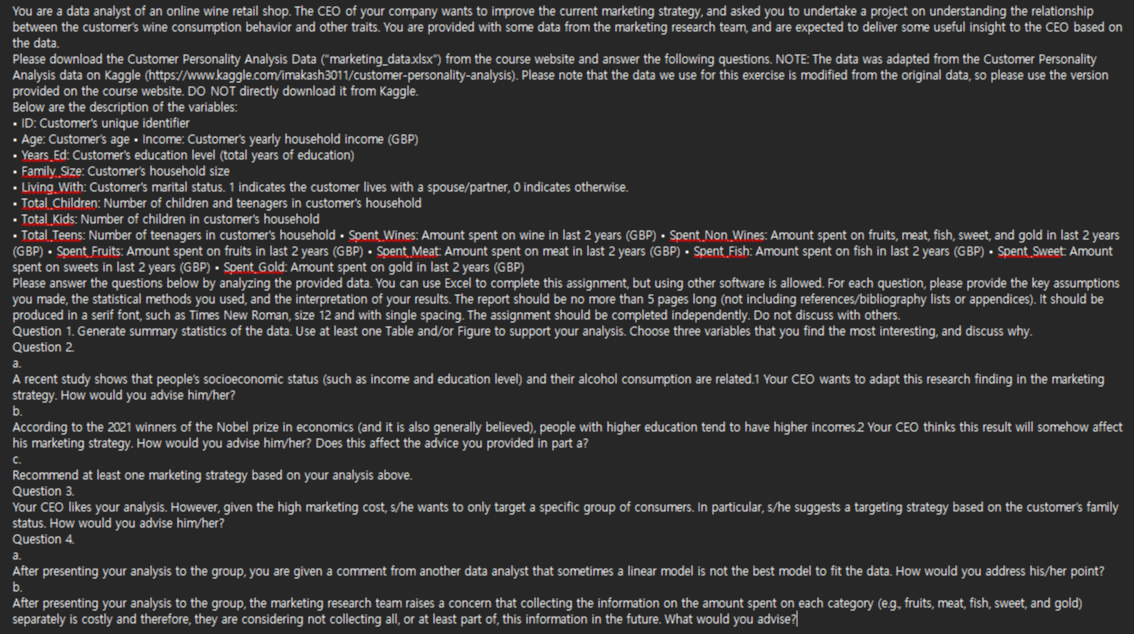
You are a data analyst of an online wine retail shop. The CEO of your company wants to improve the current marketing strategy, and asked you to undertake a project on understanding the relationship between the customer's wine consumption behavior and other traits. You are provided with some data from the marketing research team, and are expected to deliver some useful insight to the CEO based on the data. Please download the Customer Personality Analysis Data ('marketing_data.xlsx') from the course website and answer the following questions. NOTE: The data was adapted from the Customer Personality Analysis data on Kaggle (https://www.kaggle.com/imakash3011/customer-personality-analysis). Please note that the data we use for this exercise is modified from the original data, so please use the version provided on the course website. DO NOT directly download it from Kaggle. Below are the description of the variables: - ID: Customer's unique identifier - Age: Customer's age - Income: Customer's yearly household income (GBP) - Years_Ed: Customer's education level (total years of education) - Family_Size: Customer's household size - Living_With: Customer's marital status. 1 indicates the customer lives with a spouse/partner, 0 indicates otherwise. - Total_Children: Number of children and teenagers in customer's household - Total_Kids: Number of children in customer's household - Total_Teens: Number of teenagers in customer's household - Spent_Wines: Amount spent on wine in last 2 years (GBP) - Spent_Non_Wines: Amount spent on fruits, meat, fish, sweet, and gold in last 2 years (GBP) - Spent_Fruits: Amount spent on fruits in last 2 years (GBP) - Spent_Meat: Amount spent on meat in last 2 years (GBP) - Spent_Fish: Amount spent on fish in last 2 years (GBP) - Spent_Sweet: Amount spent on sweets in last 2 years (GBP) - Spent_Gold: Amount spent on gold in last 2 years (GBP) Please answer the questions below by analyzing the provided data. You can use Excel to complete this assignment, but using other software is allowed. For each question, please provide the key assumptions you made, the statistical methods you used, and the interpretation of your results. The report should be no more than 5 pages long (not including references/bibliography lists or appendices). It should be produced in a serif font, such as Times New Roman, size 12 and with single spacing. The assignment should be completed independently. Do not discuss with others. Question 1. Generate summary statistics of the data. Use at least one Table and/or Figure to support your analysis. Choose three variables that you find the most interesting, and discuss why. Question 2. a. A recent study shows that people's socioeconomic status (such as income and education level) and their alcohol consumption are related. Your CEO wants to adapt this research finding in the marketing strategy. How would you advise him/her? b. According to the 2021 winners of the Nobel prize in economics (and it is also generally believed), people with higher education tend to have higher incomes. Your CEO thinks this result will somehow affect his marketing strategy. How would you advise him/her? Does this affect the advice you provided in part a? c. Recommend at least one marketing strategy based on your analysis above. Question 3. Your CEO likes your analysis. However, given the high marketing cost, s/he wants to only target a specific group of consumers. In particular, s/he suggests a targeting strategy based on the customer's family status. How would you advise him/her? Question 4. a. After presenting your analysis to the group, you are given a comment from another data analyst that sometimes a linear model is not the best model to fit the data. How would you address his/her point? b. After presenting your analysis to the group, the marketing research team raises a concern that collecting the information on the amount spent on each category (e.g., fruits, meat, fish, sweet, and gold) separately is costly and therefore, they are considering not collecting all, or at least part of, this information in the future. What would you advise?
View Answer
divider
ANSWERED

Ivan Kochetkov verified

Numerade educator

Questions 10-15. During one flu season, 12% of patients diagnosed with flu presented severe symptoms. During the same flu season, a new anti-flu drug was being tested. The drug was given to 526 undergraduate students with the flu and only 25 of them developed severe symptoms. Based only on this information, can you conclude that the drug is a success at 99.99% confidence level? Can you infer that the new anti-flu drug alleviate the occurrence of sever symptoms for general population? Question 12. Find the test statistics 3.72 5.12 0.12 0.05 Question 13. During one flu season, 12% of patients diagnosed with flu presented severe symptoms. During the same flu season, a new anti-flu drug was being tested. The drug was given to 526 undergraduate students with the flu and only 25 of them developed severe symptoms. Based only on this information, can you conclude that the drug is a success at 99.99% confidence level? Can you infer that the new anti-flu drug alleviate the occurrence of sever symptoms for general population? Question 13. Find the critical value at 99.99% confidence level. 5.12 0.15 3.72 0.34 Question 14. During one flu season, 12% of patients diagnosed with flu presented severe symptoms. During the same flu season, a new anti-flu drug was being tested. The drug was given to 526 undergraduate students with the flu and only 25 of them developed severe symptoms. Based only on this information, can you conclude that the drug is a success at 99.99% confidence level? Can you infer that the new anti-flu drug alleviate the occurrence of sever symptoms for general population? Question 14. Find the right statement. Because t < critical value, we accept H0 at 0.05% significance level. Because t > critical value, we reject H0 at 0.05% significance level. Because t > critical value, we reject H0 at 0.01% significance level. Because t < critical value, we accept H0 at 0.01% significance level.

View Answer
divider
ANSWERED

Ivan Kochetkov verified

Numerade educator

Questions 1-9. 25 new mothers were investigated about their sleeping hours per day before and after having a baby. Researchers want to know if new mothers’ sleeping hours have been significantly reduced. Sample average and sample standard deviation of D (before - after) are computed 2.5 and 4. Please test this hypothesis at 5% significance level and calculate the p-value. Question 8. TRUE/FALSE? We are not confident that sleeping hours are reduced. FALSE TRUE Question 9. What is the p-value of the test statistics you calculated? 0.002 0.0023 0.12 0.05 Questions 10-15. During one flu season, 12% of patients diagnosed with flu presented severe symptoms. During the same flu season, a new anti-flu drug was being tested. The drug was given to 526 undergraduate students with the flu and only 25 of them developed severe symptoms. Based only on this information, can you conclude that the drug is a success at 99.99% confidence level? Can you infer that the new anti-flu drug alleviate the occurrence of sever symptoms for general population? Question 10. Find the sample proportion of people with severe symptoms who take this anti-flu drug. 0.055 0.045 0.03 0.0475 Question 11. Find the correct hypothesis H0: p= 0.05 H0: p > 0.12 H0: p= 0.12 H0 : p < 0.12

View Answer
divider
ANSWERED

Ivan Kochetkov verified

Numerade educator

Questions 1-9. 25 new mothers were investigated about their sleeping hours per day before and after having a baby. Researchers want to know if new mothers’ sleeping hours have been significantly reduced. Sample average and sample standard deviation of D (before - after) are computed 2.5 and 4. Please test this hypothesis at 5% significance level and calculate the p-value. Question 4. Find the critical value. Group of answer choices 0.13 1.03 0.05 1.71 Question 5. Make a decision. Group of answer choices Reject H0 at 5% significance level Accept H0 at 5% significance level. Question 6. TRUE/FALSE? We are confident that sleeping hours are reduced. Group of answer choices TRUE FALSE Question 7. TRUE/FALSE? We are not confident that sleeping hours are reduced. Group of answer choices TRUE FALSE

View Answer
divider
ANSWERED

Ivan Kochetkov verified

Numerade educator

Questions 1-9. 25 new mothers were investigated about their sleeping hours per day before and after having a baby. Researchers want to know if new mothers’ sleeping hours have been significantly reduced. Sample average and sample standard deviation of D (before - after) are computed as 2.5 and 4. Please test this hypothesis at 5% significance level and calculate the p-value. Question 1. Set up the hypothesis H0. Group of answer choices H0: mud = 0, H1 : mud > 0 H0: mud > 0, H1 : mud < 0 H0: mud < 0, H1 : mud = 0 H0: mud < 0, H1 : mud > 0 Questions 1-9. 25 new mothers were investigated about their sleeping hours per day before and after having a baby. Researchers want to know if new mothers’ sleeping hours have been significantly reduced. Sample average and sample standard deviation of D (before - after) are computed 2.5 and 4. Please test this hypothesis at 5% significance level and calculate the p-value. Question 2. Calculate the t-test statistics. Group of answer choices 0.24 3.13 1.71 0.95 Questions 1-9. 25 new mothers were investigated about their sleeping hours per day before and after having a baby. Researchers want to know if new mothers’ sleeping hours have been significantly reduced. Sample average and sample standard deviation of D (before - after) are computed 2.5 and 4. Please test this hypothesis at 5% significance level and calculate the p-value. Question 3. Find the degree of freedom. Group of answer choices 24 25 1 4

View Answer
divider