Ace - AI Tutor
Ask Our Educators
Textbooks
My Library
Flashcards
Scribe - AI Notes
Notes & Exams
Download App
diana lawson

diana l.

Divider

Questions asked

BEST MATCH

An A260/280 ratio of 1.8 would be a reasonable cut off for RNA that you intend to use for quantitative RT-PCR?

View Answer
divider
BEST MATCH

Question 4 Relative Velocity D km X Y wind A m/s W m/s A light aircraft flies at 63m/s in still air. It needs to fly from point X to point Y, a distance of 492km due East (bearing 090°) The wind is blowing from South to North (bearing 000°) at a speed of 14.2m/s. Calculate the bearing that the aircraft must head in order to travel from X to Y. Give your answer in degrees to 0dp. Do not include a zero in front of the answer if less than 100°, e.g. if answer is 50.223°, enter 50. 1 pts

View Answer
divider
BEST MATCH

identify and describe three social determinats of health from Healthy People 2030 initiative

View Answer
divider
BEST MATCH

Research suggests that the _____ prefrontal lobe is somewhat more involved in expressing positive emotions, while the _____ prefrontal lobe is more involved in expressing negative emotions.

View Answer
divider
BEST MATCH

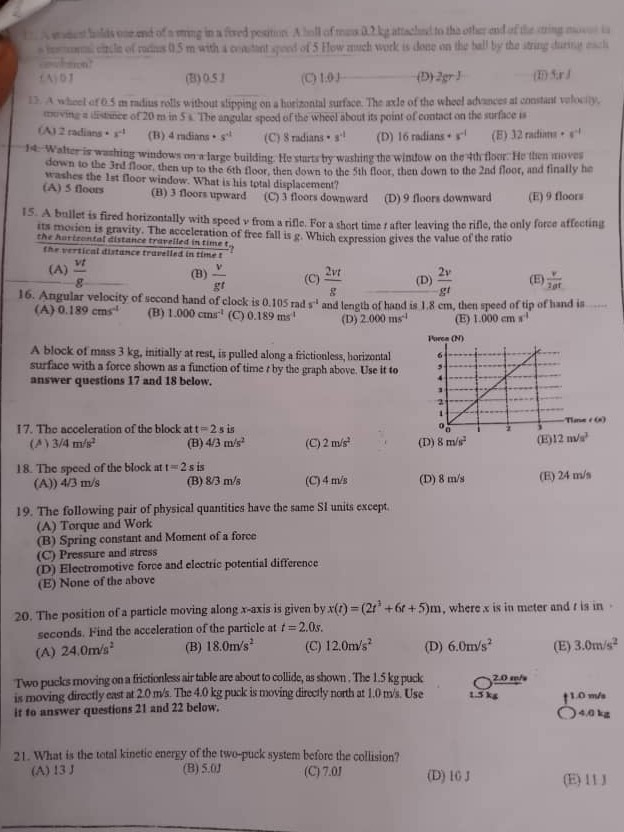
(B) 051 (C) 10 . (D) \( 2 \mathrm{gr} \) I (ii) \( \{ \) r. A 2 radians \( \cdot x^{-1} \) (B) 4 radians \( \cdot s^{4} \) (C) 8 radians \( 3^{-1} \) (D) 16 radians * \( s^{-1} \) (B) 32 fathime \( * i^{+} \) 14. Walter is watring windows on a large buitdine He starts by washing the window on the fth floor. He then mover down to the Ind floor, then up to the 6th floor, then down to the 5th floor, then down to the 2nd floor, and finally he (A) 5 floors lat floor window. What is his totial dieplacement? (A) 5 flours (B) 3 floorn upwayd (C) 3 floors downward (D) 9 floors dowmward (E) 9 floor: 15. A bullet is fired horizontally with speed \( v \) from a rifle. For a short time \( f \) after leaving the rifle, the only fored affectifnl its movien is gravity. The acceleration of free fall is \( \mathrm{g} \). Which expression gives the value of the ratio the hartiperfal distance travelled in timet (A) \( \frac{v t}{g} \) (B) \( \frac{v}{g t} \) (C) \( \frac{2 v t}{g} \) (D) \( \frac{2 v}{g t} \) (E) \( \frac{v}{3 g \mathrm{f}} \) 16. Angular velocity of sccond hand of clock is \( 0.105 \mathrm{rad} \mathrm{s}^{-1} \) and length of hand is \( 1.8 \mathrm{~cm} \), then ipeed of tip of hand is (A) \( 0.189 \mathrm{cms}^{-1} \) (B) \( 1.000 \mathrm{cms}^{-1} \) (C) \( 0.189 \mathrm{~ms}^{-1} \) (D) \( 2.000 \mathrm{~ms}^{4} \) (E) \( 1.000 \mathrm{~cm} \mathrm{n}^{\prime} \) A block of mnss \( 3 \mathrm{~kg} \), initially at rest, is pulled along a frictionless, horizontal surface with a force shown as a function of time \( r \) by the graph above. Use it to answer questions 17 and 18 below. 17. The acceleration of the block at \( t=2 \mathrm{~s} \) is (A) \( 3 / 4 \mathrm{~m} / \mathrm{s}^{2} \) (B) \( 4 / 3 \mathrm{~m} / \mathrm{s}^{2} \) (C) \( 2 \mathrm{~m} / \mathrm{s}^{2} \) (D) \( 8 \mathrm{~m} / \mathrm{s}^{3} \) (B) \( 12 \mathrm{~m} / \mathrm{s}^{3} \) 18. The speed of the block at \( t=2 \mathrm{~s} \) is (A)) \( 4 / 3 \mathrm{~m} / \mathrm{s} \) (B) \( 8 / 3 \mathrm{~m} / \mathrm{s} \) (C) \( 4 \mathrm{~m} / \mathrm{s} \) (D) \( 8 \mathrm{~m} / \mathrm{s} \) (E) \( 24 \mathrm{~m} / \mathrm{s} \) 19. The following pair of physieal quantities have the same SI units except. (A) Torque and Work (B) Spring constant and Moment of a foree (C) Pressure and atress (D) Electromotive force and electric potential difference (E) None of the above 20. The position of a particle moving along \( x \)-axis is given by \( x(t)=\left(2 t^{3}+6 t+5\right) \mathrm{m} \), where \( x \) is in meter and \( t \) is in seconds. Find the acceleration of the particle at \( t=2.0 \mathrm{~s} \). (A) \( 24,0 \mathrm{~m} / \mathrm{s}^{2} \) (B) \( 18.0 \mathrm{~m} / \mathrm{s}^{2} \) (C) \( 12.0 \mathrm{~m} / \mathrm{s}^{2} \) (D) \( 6.0 \mathrm{~m} / \mathrm{s}^{2} \) (E) \( 3.0 \mathrm{~m} / \mathrm{s}^{2} \) Two pucks moving on a frictionless air table ane about to collide, as shown, The \( 1.5 \mathrm{~kg} \) puck is moving directly cast at \( 2.0 \mathrm{~m} / \mathrm{s} \). The \( 4.0 \mathrm{~kg} \) puck is moving directly north at \( 1.0 \mathrm{~m} / \mathrm{s} \). Use it to answer questions 21 and 22 below. \( \mathrm{C}_{1.3 \mathrm{ks}}^{20 \mathrm{~m}} \) 21. What is the total kinetic energy of the two-puck system betore the collision? (A) \( 13 \mathrm{~s} \) (B) \( 5.0 \mathrm{~J} \) (C) 7.0 I (D) \( 16 \mathrm{~J} \) (E) \( 11 \mathrm{~J} \)
View Answer
divider
BEST MATCH

11. What is the osmolarity of 2.0 L of an aqueous solution containing 20.5 g of $Na_2SO_4$? 12. What mass of $PO_4^{3-}$ would be needed for 0.45 Eq. of $PO_4^{3-}$?

View Answer
divider
BEST MATCH

What volume (L)of 0.05 M HCl solution can be prepared by diluting 250 mL of 10 M HCl?

View Answer
divider
BEST MATCH

Consider a simple liquid-phase, irreversible chemical reaction where chemical species A reacts to form species B. The reaction can be written as A -> B. We assume that the rate of the reaction is first-order with respect to component A: r = kC, where k is the reaction rate constant. For single-phase reactions, the rate constant is typically a strong function of reaction temperature given by the Arrhenius relation, k = ko * exp(E / RT), where ko is the frequency factor, E is the activation energy, and R is the gas constant. The schematic diagram of the CSTR is shown in the following figure. The inlet stream consists of pure component A with molar concentration, CA. A cooling coil is used to maintain the reaction mixture at the desired operating temperature by removing heat that is released in the exothermic reaction (Q = UA(T - Tc)). Let CA and CP represent the molar concentrations of A and B, respectively. Assumptions: (1) The CSTR is perfectly mixed. (2) The mass densities of the feed and product streams are equal and constant (p). (3) The liquid volume V in the reactor is kept constant by an overflow line. Derive dynamic model of the CSTR, define & identify state variables (input-output), and perform degree of freedom analysis. And list your model result in a table below: 2. Define control objectives and propose possible control configuration of the CSTR! Draw the schematic diagram of your proposed control configuration! Identify CV, MV, and LV for your control system. Derive input-output process model (transfer function) of the CSTR. Plot temperature reaction and outlet C concentration over the times (10 min) by performing process simulation for two following cases: a. Increase cooling by changing Tc from 300 K to 290 K (other variables using initial steady state condition). b. Increase heating by changing Tc from 300 K to 305 K (other variables using initial steady state condition). The CSTR parameters and their steady state condition are described as follows: Parameter Value F1 100 L/min CA0 1M T1 350 K A 100 L p 1000 g/L ko 239 J(g.K)^-1 E/R 5 * 10^4 J/mol oy 7.2 * 10^10 min^-1 UA 8750 K Tc(0) 300 K CA(0) 0.5 mol/L T(0) 350 K

View Answer
divider
BEST MATCH

Exercises 1. Using strcat and strcmp functions, write a C program that asks the user to enter 2 strings (string1 and string2), then compares string1 and string2. After comparison, your program will concatenate first 3 characters of string2 to string 1. Sample Run: Enter string 1: abcd Enter string2: efgh String1 is < string2 After concatenation, string1=abcdefg

View Answer
divider
BEST MATCH

5. Suppose a particle of mass m, in a tube of length L, is in the ground state. The tube is suddenly stretched to twice its length, by moving one end of the tube to a new position at x = 2L. Immediately after the tube is stretched, the wave function of the particle is the same as before (it takes time for a wave function to change). If we now measure the energy of the particle, what energy is most likely to be found?

View Answer
divider