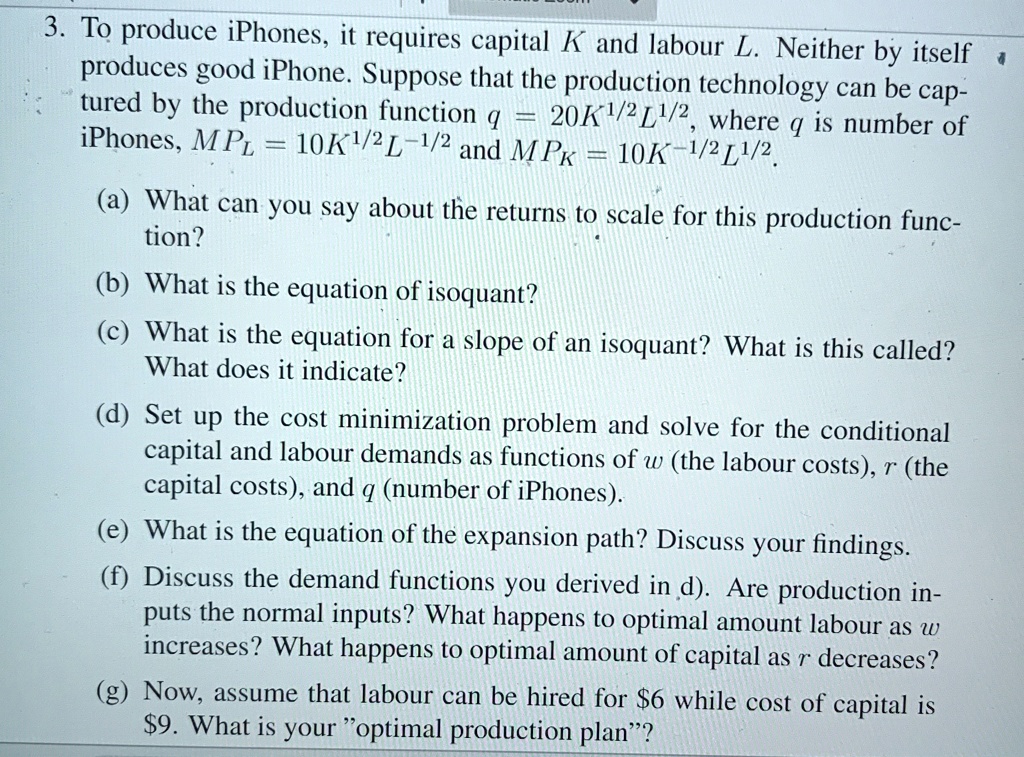
3. To produce iPhones, it requires capital K and labour L. Neither by itself produces good iPhone. Suppose that the production technology can be captured by the production function $q = 20K^{1/2}L^{1/2}$, where q is number of iPhones, $MPL = 10K^{1/2}L^{-1/2}$ and $MPK = 10K^{-1/2}L^{1/2}$.
(a) What can you say about the returns to scale for this production function?
(b) What is the equation of isoquant?
(c) What is the equation for a slope of an isoquant? What is this called? What does it indicate?
(d) Set up the cost minimization problem and solve for the conditional capital and labour demands as functions of $w$ (the labour costs), $r$ (the capital costs), and $q$ (number of iPhones).
(e) What is the equation of the expansion path? Discuss your findings.
(f) Discuss the demand functions you derived in d). Are production inputs the normal inputs? What happens to optimal amount labour as $w$ increases? What happens to optimal amount of capital as $r$ decreases?
(g) Now, assume that labour can be hired for $6 while cost of capital is $9. What is your \"optimal production plan\"?