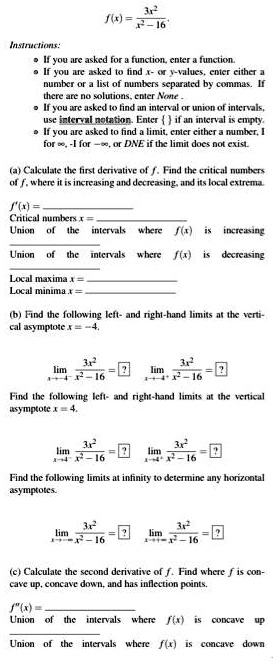
Instructions:
\(f(x) = \frac{3x^2}{x^2 - 16}\)
• If you are asked for a function, enter a function.
• If you are asked to find x- or y-values, enter either a
number or a list of numbers separated by commas. If
there are no solutions, enter None.
• If you are asked to find an interval or union of intervals,
use interval notation. Enter {} if an interval is empty.
• If you are asked to find a limit, enter either a number, I
for ?, -I for -?, or DNE if the limit does not exist.
(a) Calculate the first derivative of f. Find the critical numbers
of f, where it is increasing and decreasing, and its local extrema.
f'(x) =
Critical numbers x =
Union of the intervals where f(x) is increasing
Union of the intervals where f(x) is decreasing
Local maxima x =
Local minima x =
(b) Find the following left- and right-hand limits at the verti-
cal asymptote x = -4.
\(\lim_{x \to -4^-} \frac{3x^2}{x^2 - 16} = \text{?}\)
\(\lim_{x \to -4^+} \frac{3x^2}{x^2 - 16} = \text{?}\)
Find the following left- and right-hand limits at the vertical
asymptote x = 4.
\(\lim_{x \to 4^-} \frac{3x^2}{x^2 - 16} = \text{?}\)
\(\lim_{x \to 4^+} \frac{3x^2}{x^2 - 16} = \text{?}\)
Find the following limits at infinity to determine any horizontal
asymptotes.
\(\lim_{x \to -\infty} \frac{3x^2}{x^2 - 16} = \text{?}\)
\(\lim_{x \to \infty} \frac{3x^2}{x^2 - 16} = \text{?}\)
(c) Calculate the second derivative of f. Find where f is con-
cave up, concave down, and has inflection points.
f''(x) =
Union of the intervals where f(x) is concave up
Union of the intervals where f(x) is concave down