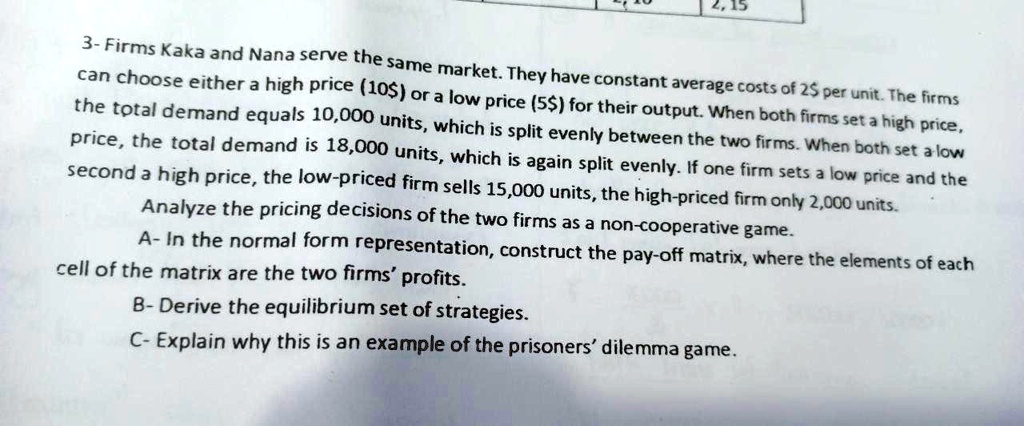
3- Firms Kaka and Nana serve the same market. They have constant average costs of 2\$ per unit. The firms can choose either a high price (10\$) or a low price (5\$) for their output. When both firms set a high price, the total demand equals 10,000 units, which is split evenly between the two firms. When both set a low price, the total demand is 18,000 units, which is again split evenly. If one firm sets a low price and the second a high price, the low-priced firm sells 15,000 units, the high-priced firm only 2,000 units.
Analyze the pricing decisions of the two firms as a non-cooperative game.
A- In the normal form representation, construct the pay-off matrix, where the elements of each cell of the matrix are the two firms' profits.
B- Derive the equilibrium set of strategies.
C- Explain why this is an example of the prisoners' dilemma game.