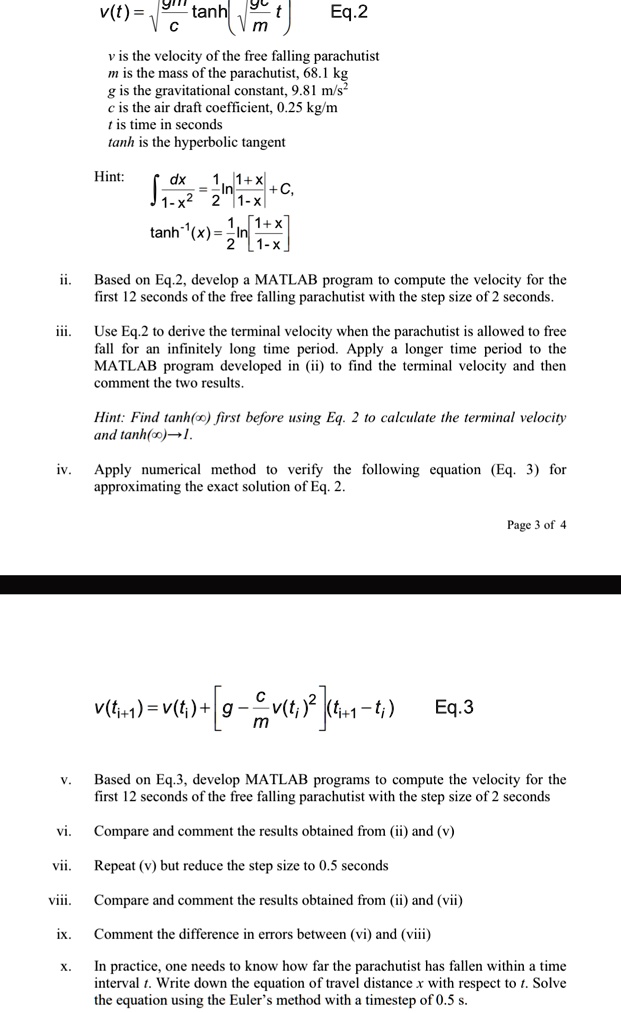
v(t)=sqrt((gm)/(c))tanh(sqrt((gc)/(m))t), Eq. 2
v is the velocity of the free falling parachutist
m is the mass of the parachutist, 68.1kg
g is the gravitational constant, 9.81(m)/(s^(2))
c is the air draft coefficient, 0.25k(g)/(m)
t is time in seconds
tanh is the hyperbolic tangent
Hint:
int (dx)/(1-x^(2))=(1)/(2)ln|(1+x)/(1-x)|+C,
tanh^(-1)(x)=(1)/(2)ln[(1+x)/(1-x)]
ii. Based on Eq.2, develop a MATLAB program to compute the velocity for the first 12 seconds of the free falling parachutist with the step size of 2 seconds.
iii. Use Eq. 2 to derive the terminal velocity when the parachutist is allowed to free fall for an infinitely long time period. Apply a longer time period to the MATLAB program developed in (ii) to find the terminal velocity and then comment the two results. and tanh(infty )->1.
iv. Apply numerical method to verify the following equation (Eq. 3) for approximating the exact solution of Eq. 2 .
Page 3 of 4
v(t_(i+1))=v(t_(i))+[g-(c)/(m)v(t_(i))^(2)](t_(i+1)-t_(i)), Eq. 3
v. Based on Eq.3, develop MATLAB programs to compute the velocity for the first 12 seconds of the free falling parachutist with the step size of 2 seconds
vi. Compare and comment the results obtained from (ii) and (v)
vii. Repeat (v) but reduce the step size to 0.5 seconds
viii. Compare and comment the results obtained from (ii) and (vii)
ix. Comment the difference in errors between (vi) and (viii)
x. In practice, one needs to know how far the parachutist has fallen within a time interval t. Write down the equation of travel distance x with respect to t. Solve the equation using the Euler's method with a timestep of 0.5s.
Eq.2
v is the velocity of the free falling parachutist m is the mass of the parachutist, 68.1 kg g is the gravitational constant, 9.81 m/s c is the air draft coefficient, 0.25 kg/m t is time in seconds tanh is the hyperbolic tangent
Hint:
tanh-x
ii.
Based on Eq.2, develop a MATLAB program to compute the velocity for the first 12 seconds of the free falling parachutist with the step size of 2 seconds.
iii.
Use Eq.2 to derive the terminal velocity when the parachutist is allowed to free fall for an infinitely long time period. Apply a longer time period to the MATLAB program developed in (ii to find the terminal velocity and then comment the two results.
Hint: Find tanh(c first before using Eq.2 to calculate the terminal velocity and tanh(-1
iv.
Apply numerical method to verify the following equation (Eq. 3 for approximating the exact solution of Eq. 2.
Page 3 of 4
vti+1=vt+
Eq.3
V.
Based on Eq.3, develop MATLAB programs to compute the velocity for the first 12 seconds of the free falling parachutist with the step size of 2 seconds
vi.
Compare and comment the results obtained from (ii) and (v)
vii.
Repeat (v) but reduce the step size to 0.5 seconds
viii.
Compare and comment the results obtained from (ii) and (vii)
ix.
Comment the difference in errors between (vi and (viii
X.
In practice, one needs to know how far the parachutist has fallen within a time interval t. Write down the equation of travel distance x with respect to t. Solve the equation using the Euler's method with a timestep of 0.5 s.