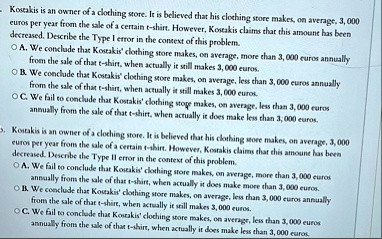
1. Kostakis is an owner of a clothing store. It is believed that his clothing store makes, on average, 3,000 euros per year from the sale of a certain t-shirt. However, Kostakis claims that this amount has been decreased. Describe the Type I error in the context of this problem.
A. We conclude that Kostakis' clothing store makes, on average, more than 3,000 euros annually from the sale of that t-shirt, when actually it still makes 3,000 euros.
B. We conclude that Kostakis' clothing store makes, on average, less than 3,000 euros annually from the sale of that t-shirt, when actually it still makes 3,000 euros.
C. We fail to conclude that Kostakis' clothing store makes, on average, less than 3,000 euros annually from the sale of that t-shirt, when actually it does make less than 3,000 euros.
2. Kostakis is an owner of a clothing store. It is believed that his clothing store makes, on average, 3,000 euros per year from the sale of a certain t-shirt. However, Kostakis claims that this amount has been decreased. Describe the Type II error in the context of this problem.
A. We fail to conclude that Kostakis' clothing store makes, on average, more than 3,000 euros annually from the sale of that t-shirt, when actually it does make more than 3,000 euros.
B. We conclude that Kostakis' clothing store makes, on average, less than 3,000 euros annually from the sale of that t-shirt, when actually it still makes 3,000 euros.
C. We fail to conclude that Kostakis' clothing store makes, on average, less than 3,000 euros annually from the sale of that t-shirt, when actually it does make less than 3,000 euros.