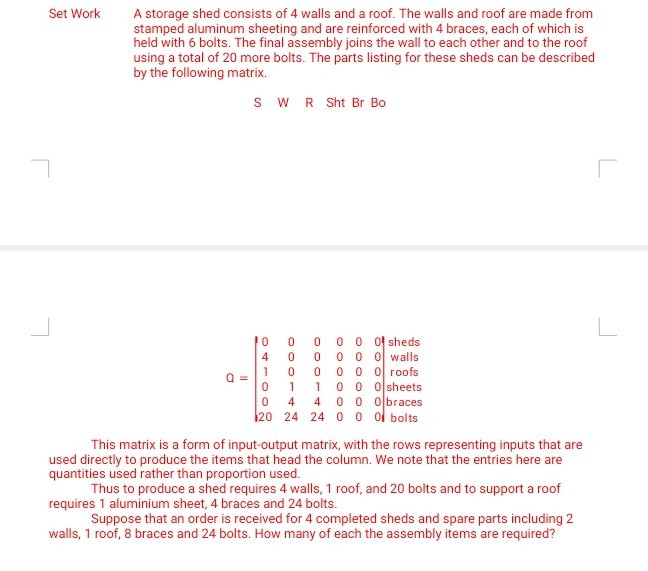
Set Work A storage shed consists of 4 walls and a roof. The walls and roof are made from stamped aluminum sheeting and are reinforced with 4 braces, each of which is held with 6 bolts. The final assembly joins the wall to each other and to the roof using a total of 20 more bolts. The parts listing for these sheds can be described by the following matrix.
S W R Sht Br Bo
\[
\mathrm{Q}=\left\lvert\, \begin{array}{cccccc|c}
0 & 0 & 0 & 0 & 0 & 0 & 0 \\
4 & 0 & 0 & 0 & 0 & 0 & \text { sheds } \\
1 & 0 & 0 & 0 & 0 & 0 & \text { walls } \\
\text { roofs } \\
0 & 1 & 1 & 0 & 0 & 0 & \text { sheets } \\
0 & 4 & 4 & 0 & 0 & 0 & \text { braces } \\
20 & 24 & 24 & 0 & 0 & 0 & \text { bolts }
\end{array}\right.
\]
This matrix is a form of input-output matrix, with the rows representing inputs that are used directly to produce the items that head the column. We note that the entries here are quantities used rather than proportion used.
Thus to produce a shed requires 4 walls, 1 roof, and 20 bolts and to support a roof requires 1 aluminium sheet, 4 braces and 24 bolts.
Suppose that an order is received for 4 completed sheds and spare parts including 2 walls, 1 roof, 8 braces and 24 bolts. How many of each the assembly items are required?