Ace - AI Tutor
Ask Our Educators
Textbooks
My Library
Flashcards
Scribe - AI Notes
Notes & Exams
Download App
domingo tanner

domingo t.

Divider

Questions asked

BEST MATCH

point Which of the following is most closely related to the conservation of energy? While the capacitor plates are connected to a battery, the charge on each plate remains the same. While the capacitor plates are isolated, the charge on each plate remains the same. While the capacitor plates are isolated, the voltage between the plates remains the same. While the capacitor plates are connected to a battery, the voltage between the plates remains the same.

View Answer
divider
BEST MATCH

Which of the following can be used in children and infants to diagnose whooping cough? Group of answer choices A) O&P test B) Sweat chloride test C) urine D) nasopharyngeal culture

View Answer
divider
BEST MATCH

Which of the following is true of SSL? Select one: a. It provides security at the data-link layer. b. It is a simple protocol with limited options. c. It is commonly used for secure communication on the Internet. d. It was designed by Microsoft.

View Answer
divider
BEST MATCH

A coupon bond that pays interest of $90 annually has a par value of $1000, matures in 7 years, and is selling today at a $20 premium from par value. The yield to maturity on this bond is _________. Note: Express your answers in strictly numerical terms. For example, if the answer is 5%, write 0.05"

View Answer
divider
BEST MATCH

In this problem you will solve the non-homogeneous differential equation y" + 4y = sec^2(2x) on the interval -?/4 < x < ?/4. (1) Let $C_1$ and $C_2$ be arbitrary constants. The general solution of the related homogeneous differential equation y" + 4y = 0 is the function $y_h(x) = C_1 y_1(x) + C_2 y_2(x) = C_1 \sin(2x) + C_2 \cos(2x)$. (2) The particular solution $y_p(x)$ to the differential equation y" + 4y = sec^2(2x) is of the form $y_p(x) = y_1(x) u_1(x) + y_2(x) u_2(x)$ where $u_1(x) = \frac{1}{2 \cos(2x)}$ and $u_2(x) = -\frac{1}{2} \tan(2x) \sec(2x)$. (3) It follows that $u_1(x) = \frac{1}{4} \ln(|\sec(2x) + \tan(2x)|)$ and $u_2(x) = -\frac{1}{4} \sec(2x)$; thus $y_p(x) = \boxed{}$ (4) Therefore, on the interval (-?/4, ?/4), the most general solution of the non-homogeneous differential equation y" + 4y = sec^2(2x) is y = $C_1 \cos(2x) + C_2 \sin(2x) + \boxed{}$

View Answer
divider
BEST MATCH

1) The direction of the magnetic field of an electromagnetic wave is always ____ to the direction of the electric field and direction of propagation of the wave is ____ to the direction of both the electric and magnetic fields.

View Answer
divider
BEST MATCH

2. B 1 3 3 8 A -2 F D 11 -3 2 2 1 G C -9 2 F (a) Even though the graph has negative weight edges, step through Dijkstra's algorithm to calculate supposedly shortest paths from A to every other vertex. Show your steps in a table. Cross out old values and write in new ones, from left to right within each cell, as the algorithm proceeds. Also list the vertices in the order which you marked them known. (b) Did Dijkstra's algorithm find the wrong path to some of the vertices? For just the vertices where the wrong path was computed, indicate both the path that was computed and the correct path. (c) Can a single edge be removed from the graph such that Dijkstra's algorithm would happen to compute correct answers for all vertices in the remaining graph? If so, which one?

View Answer
divider
BEST MATCH

QUESTION 5 Use the following recursive relation to calculate F(15) F(n) = F(n-1) - F(n-2) where F(0) = 0, and F(1) = 1. (Note that the formula is NOT for the Fibonacci Series).

View Answer
divider
BEST MATCH

22. An opportunity cost is: A sunk cost A direct cost. A cost of potential benefit lost. An uncontrollable cost A change in the cost of a component.

View Answer
divider
BEST MATCH

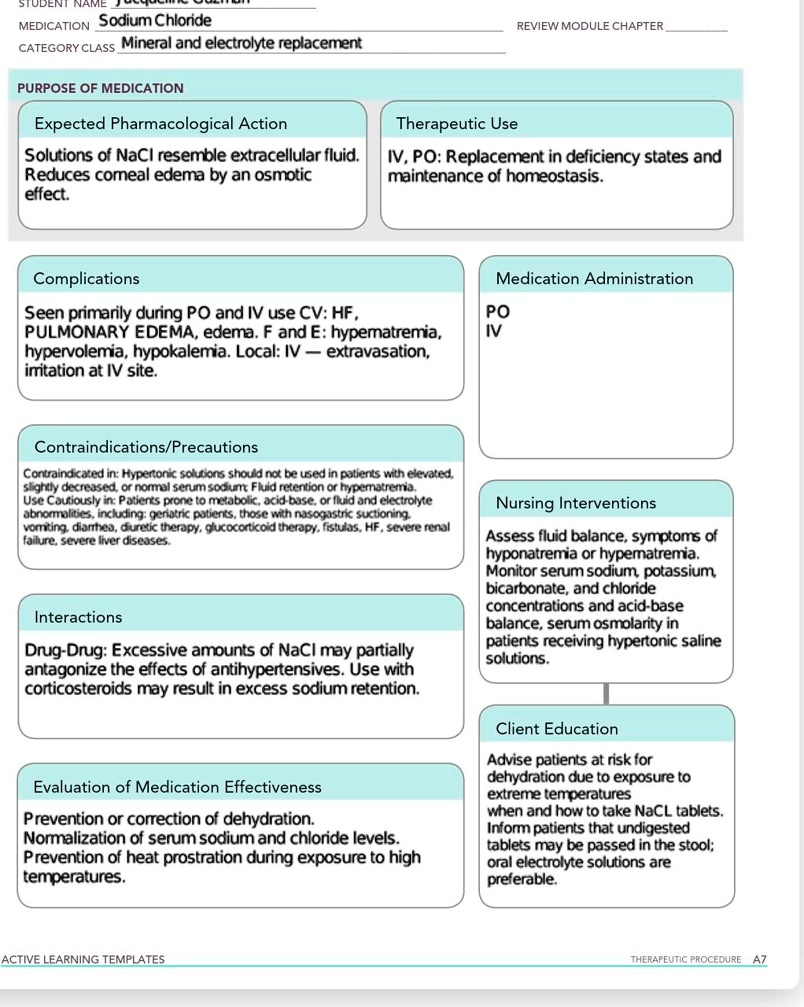
Can someone do blood production templates like this? 1. Whole blood 2. Packed RBCs 3. Platelets 4. Platelets The example of a template like this is shown below and with references. This template above is an example. STUDENT NAME MEDICATION: Sodium Chloride CATEGORY/CLASS: Mineral and electrolyte replacement REVIEW MODULE CHAPTER: PURPOSE OF MEDICATION: Expected Pharmacological Action Therapeutic Use Solutions of NaCl resemble extracellular fluid. Reduces corneal edema by an osmotic effect. IV/PO: Replacement in deficiency states and maintenance of homeostasis Complications: Medication Administration Seen primarily during PO and IV use CV: HF, PULMONARY EDEMA, edema F and E: hypernatremia, hypervolemia, hypokalemia Local: IV-extravasation, irritation at IV site PO IV Contraindications/Precautions: Contraindicated in hypertonic solutions should not be used in patients with elevated slightly decreased, or normal serum sodium. Fluid retention or hypernatremia. Use cautiously in patients prone to metabolic, acid-base, or fluid and electrolyte abnormalities, including geriatric patients, those with nasogastric suctioning, vomiting, diarrhea, diuretic therapy, glucocorticoid therapy, fistulas, HF, severe renal failure, severe liver diseases. Nursing Interventions: Assess fluid balance, symptoms of hyponatremia or hypernatremia. Monitor serum sodium, potassium, bicarbonate, and chloride concentrations and acid-base balance, serum osmolarity in patients receiving hypertonic saline solutions. Interactions: Drug-Drug: Excessive amounts of NaCl may partially antagonize the effects of antihypertensives. Use with corticosteroids may result in excess sodium retention. Client Education: Advise patients at risk for dehydration due to exposure to extreme temperatures when and how to take NaCl tablets. Inform patients that undigested tablets may be passed in the stool; oral electrolyte solutions are preferable. Evaluation of Medication Effectiveness: Prevention or correction of dehydration. Normalization of serum sodium and chloride levels. Prevention of heat prostration during exposure to high temperatures. ACTIVE LEARNING TEMPLATES THERAPEUTIC PROCEDURE A7
View Answer
divider