This assignment is a simple task to get you started and familiarize yourself with whatever computer system you decide to work on. The first part of the project is to write an input and output interface for your program You must input the following parameters in order to describe the problem:
h/2 Last layer (top)
ze -0 -Lc
Core
-h/2 1st layer (bottom)
Material properties: modulus parameters. In order to form a material property stiffness matrix, the following parameters are required: Ex. Ey, Es, and vx (Poisson's ratio). Material properties: strength parameters. Five necessary strength parameters required. (To be discussed in a later chapter. They are similar to "yield strength" or "ultimate strength" in an isotropic material.): Xt, Xc, Yt, Yc, and Sc-
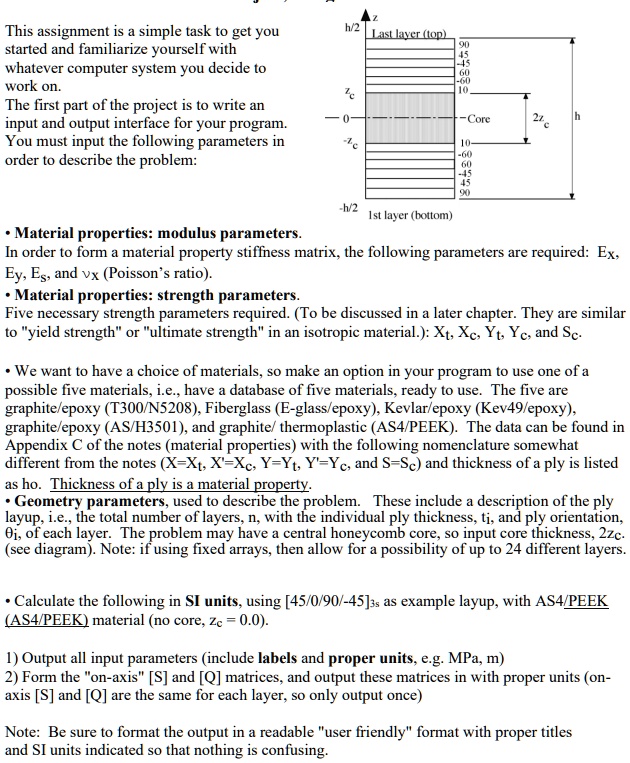
We want to have a choice of materials, so make an option in your program to use one of a possible five materials, i.e., have a database of five materials, ready to use. The five are graphite/epoxy (T300/N5208), Fiberglass (E-glass/epoxy), Kevlar/epoxy (Kev49/epoxy). graphite/epoxy (AS/H3501), and graphite/ thermoplastic (AS4/PEEK). The data can be found in Appendix C of the notes (material properties) with the following nomenclature somewhat different from the notes (X=Xt, X=Xc, Y=Yt, Y=Yc, and S=Sc) and thickness of a ply is listed as ho. Thickness of a ply is a material property. Geometry parameters, used to describe the problem.These include a description of the ply layup, i.e., the total number of layers, n, with the individual ply thickness, ti, and ply orientation. Oi, of each layer. The problem may have a central honeycomb core, so input core thickness, 2zc (see diagram). Note: if using fixed arrays, then allow for a possibility of up to 24 different layers
Calculate the following in SI units, using [45/0/90/-45]3s as example layup, with AS4/PEEK (AS4/PEEK) material (no core, zc = 0.0).
1) Output all input parameters (include labels and proper units, e.g. MPa, m) 2) Form the on-axis [S] and [Q] matrices, and output these matrices in with proper units (on- axis [S] and [Q] are the same for each layer, so only output once)
Note: Be sure to format the output in a readable "user friendly" format with proper titles and SI units indicated so that nothing is confusing.