Questions asked
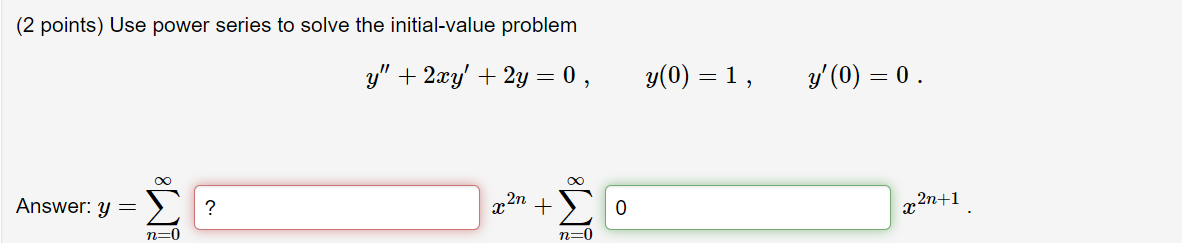
(2 points) Use power series to solve the initial-value problem \[ y^{\prime \prime}+2 x y^{\prime}+2 y=0, \quad y(0)=1, \quad y^{\prime}(0)=0 \] Answer: \( y=\sum_{n=0}^{\infty} ? \) \( x^{2 n}+\sum_{n=0}^{\infty} \) \( x^{2 n+1} \)
(2 points) Find two linearly independent solutions of \( 2 x^{2} y^{\prime \prime}-x y^{\prime}+(-2 x+1) y=0, x>0 \) of the form \[ \begin{array}{l} y_{1}=x^{r_{1}}\left(1+a_{1} x+a_{2} x^{2}+a_{3} x^{3}+\cdots\right) \\ y_{2}=x^{r_{2}}\left(1+b_{1} x+b_{2} x^{2}+b_{3} x^{3}+\cdots\right) \end{array} \] where \( r_{1}>r_{2} \). Enter \[ \begin{array}{l} r_{1}=1 \\ a_{1}=2 / 3 \\ a_{2}=4 / 30 \\ a_{3}=16 / 30 \\ r_{2}=0.5 \\ b_{1}=2 \\ b_{2}=4 / 6 \\ b_{3}=-4 / 18 \end{array} \]
Hemraj Kumawat
Numerade educator
Use the Laplace transform to solve the following initial value problem: y'' + 4y' + 53y = ?(t - 4) y(0) = 0, y'(0) = 0 Use step(t-c) for u_c(t). y(t) =
Find the inverse Laplace transform of F(s) = e^(-6s) / (s^2 + 3s - 4) f(t) = ? (Use step(t-c) for u_c(t).)