Ace - AI Tutor
Ask Our Educators
Textbooks
My Library
Flashcards
Scribe - AI Notes
Notes & Exams
Download App
donald cochran

donald c.

Divider

Questions asked

BEST MATCH

Arrange the steps of the tissue oxygenation cascade in order of occurrence.

View Answer
divider
BEST MATCH

The tubular structure of the inner ear that contains the Organ of Corti is called? oval window perilymph cochlea eustachian tube

View Answer
divider
BEST MATCH

Persuasion is an attempt to motivate others to adopt or maintain a way of thinking or acting. Which of the following words is the most similar in meaning? O logic O manipulation O urging O coercion

View Answer
divider
BEST MATCH

Patients who undergo screening for HIV or AIDS infection should sign an additional _____________. Question 2 options: a) appropriate release of information, but not for to release HIV/AIDS information. b) patient confidentiality to confirm their position. c) HIPAA statement of release. d) authorization statement for release of information regarding their HIV/AIDS status.

View Answer
divider
BEST MATCH

In IaaS, PaaS, and SaaS service models, the consumer always has control over which abstraction layer? - application - middleware - operating system - hardware

View Answer
divider
BEST MATCH

Which range of difficulty should normally be used to develop standards? Multiple Choice Practical standards Ideal standards Inflated standards Lax standards

View Answer
divider
BEST MATCH

3) Draw the mechanism for the nitration of benzene using nitric acid. 4) Care has to be taken when working with nitric acid because it is an oxidizer. What are some precautions that should be taken when segregating nitric acid waste streams?

View Answer
divider
BEST MATCH

- What is their sugar of preference in dental carries? What does it break it down to form?

View Answer
divider
BEST MATCH

A) Design a multi-stage amplifier to the following specifications: Av = +300 - No Load RIN > 10 ?? Ro < 50 ? fLOW < 50 Hz fHIGH > 100 KHz Must support an undistorted 3.0V(p-p) sinewave output into a 1 Megohm RLoad (10mvp-p nominal input) Must support an undistorted 2.0V(p-p) sinewave output into a 100ohm RLoad (Input may be adjusted up or down as necessary to demonstrate this)

View Answer
divider
BEST MATCH

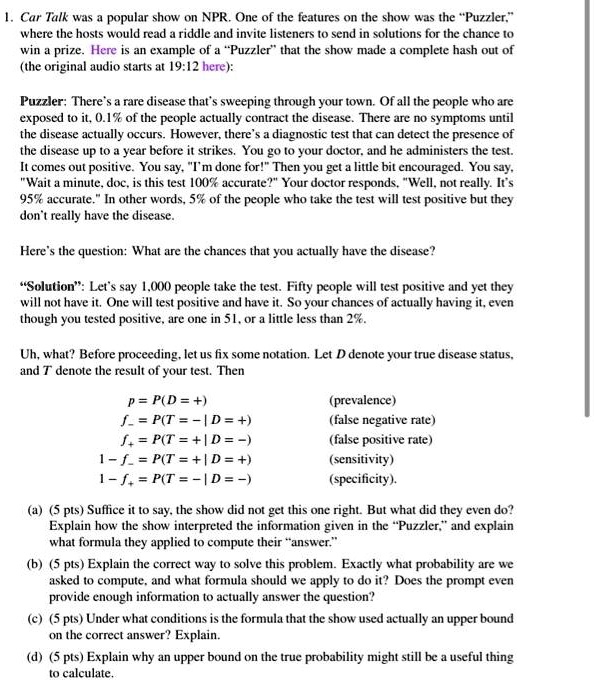
Car Talk was a popular show on NPR. One of the features on the show was the Puzzler where the hosts would read a riddle and invite listeners to send in solutions for the chance to win a prize. Here is an example of a Puzzler that the show made a complete hash out of (the original audio starts at 19:12 here): Puzzler: There's a rare disease that's sweeping through your town. Of all the people who are exposed to it, 0.1% of the people actually contract the disease. There are no symptoms until the disease actually occurs. However, there's a diagnostic test that can detect the presence of the disease up to a year before it strikes. You go to your doctor, and he administers the test. It comes out positive. You say, "I'm done for!" Then you get a little bit encouraged. You say, "Wait a minute, doc, is this test 100% accurate?" Your doctor responds, "Well, not really. It's 95% accurate. In other words, 5% of the people who take the test will test positive but they don't really have the disease." Here's the question: What are the chances that you actually have the disease? Solution: Let's say 1,000 people take the test. Fifty people will test positive and yet they will not have it. One will test positive and have it. So your chances of actually having it, even though you tested positive, are one in 51, or a little less than 2%. Uh, what? Before proceeding, let us fix some notation. Let D denote your true disease status and T denote the result of your test. Then: p = P(D=+) = f = P(T=+) | D=+ f = P(T=+) | D=- 1 - f = P(T=+) | D=+ 1 - f = P(T=+) | D=- (prevalence) (false negative rate) (false positive rate) (sensitivity) (specificity). (a) Suffice it to say, the show did not get this one right. But what did they even do? Explain how the show interpreted the information given in the Puzzler and explain. (b) Explain the correct way to solve this problem. Exactly what probability are we asked to compute, and what formula should we apply to do it? Does the prompt even provide enough information to actually answer the question? (c) Under what conditions is the formula that the show used actually an upper bound on the correct answer? Explain. (d) Explain why an upper bound on the true probability might still be a useful thing to calculate.
View Answer
divider