Ace - AI Tutor
Ask Our Educators
Textbooks
My Library
Flashcards
Scribe - AI Notes
Notes & Exams
Download App
donald fuller

donald f.

Divider

Questions asked

BEST MATCH

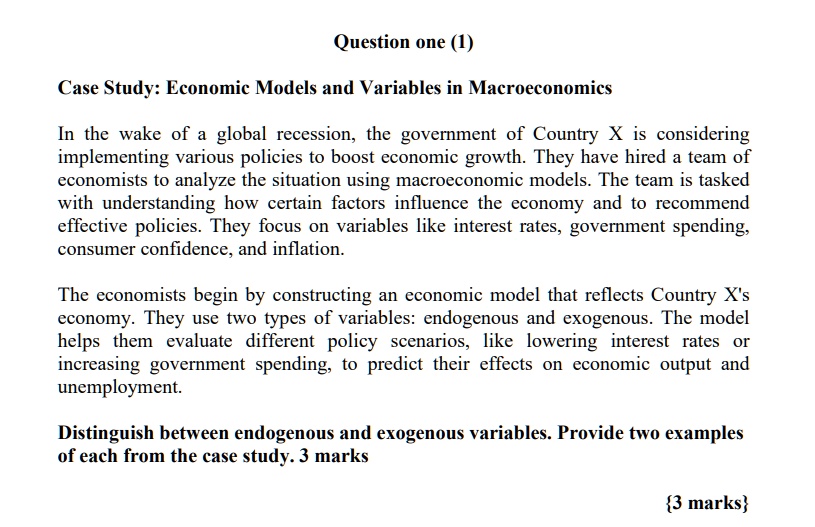
Question one (1) Case Study: Economic Models and Variables in Macroeconomics In the wake of a global recession, the government of Country X is considering implementing various policies to boost economic growth. They have hired a team of economists to analyze the situation using macroeconomic models. The team is tasked with understanding how certain factors influence the economy and to recommend effective policies. They focus on variables like interest rates, government spending, consumer confidence, and inflation. The economists begin by constructing an economic model that reflects Country X's economy. They use two types of variables: endogenous and exogenous. The model helps them evaluate different policy scenarios, like lowering interest rates or increasing government spending, to predict their effects on economic output and unemployment. Distinguish between endogenous and exogenous variables. Provide two examples of each from the case study. 3 marks {3 marks}
View Answer
divider
BEST MATCH

1. Multiply out and simplify to get a Sum or Products $(A+B)(C+B)(\bar{D}+B)(ACD+E)$

View Answer
divider
BEST MATCH

A pitcher tosses a baseball directly upwards along a vertical direction with an initial speed of 45.7 km/h. Assume the baseball follows the same path for the full up-down flight. Ignore air resistance. Show all your work for full credit. Draw the scenario mentioned in the question. List the known quantities in the scenario. Convert all quantities to fundamental units. How long does the ball take to reach its maximum height? What is the ball's maximum height above its release point? How long does the ball take to reach a point 3.0 m above its release point?

View Answer
divider
BEST MATCH

{"prefixText":"","replyText":null,"HTMLContent":"A 180 turn coil has an area of 3.1cm^(2) and rotates in a magnetic field of 0.5 T .\n(a) What frequency will generate a maximum EMF of 10 V ?\nâ—» Hz â—» 0 attempt(s) made (maximum allowed for credit =5 ) [after that, multiply credit by 0.5 up to 10 attempts]\n\nA 180 turn coil has an area of 3.1cm^(2) and rotates in a magnetic field of 0.5 T .\n(a) What frequency will generate a maximum EMF of 10 V ?\nâ—» Hz â—»\n0 attempt(s) made (maximum allowed for credit =5 )\n[after that, multiply credit by 0.5 up to 10 attempts]"}

View Answer
divider
BEST MATCH

Under normal conditions, what is the pO2 if 50% of hemoglobin molecules are saturated with oxygen? 100 There isn't a way to tell. 35 mmHg 75 mmHg 50 mmHg 15 mmHg Haemoglobin saturation (%) 90 80 70 60 50 40 30 20 10 0 10 20 30 40 50 60 70 80 90 100 110 120 Partial pressure of oxygen (pO2) (mmHg)

View Answer
divider
BEST MATCH

The principle of operation of a transformer is based on:* - A. Ohm's Law - B. Lenz's Law - C. Faraday's Law of Electromagnetic Induction - D. Coulomb's Law

View Answer
divider
BEST MATCH

\hat{P}_1 = \frac{33}{57} = 0.5790 \quad 1 - \alpha = 0.98 \\ \hat{P}_2 = \frac{14}{47} = 0.2979 \quad \alpha = 0.02 \\ \quad z_{\alpha/2} = z_{0.01} = 2.33 \\ 98\% \text{ C.I.:} \\ \hat{P}_1 - \hat{P}_2 \pm z_{\alpha/2} \sqrt{\frac{\hat{P}_1 \hat{q}_1}{N_1} + \frac{\hat{P}_2 \hat{q}_2}{N_2}} \\ = (0.5790 - 0.2979) \pm 2.33 \sqrt{\frac{0.5790 \times 0.4210}{57} + \frac{0.2979 \times 0.7021}{47}} \\ \boxed{0.0634} \text{ and } \boxed{0.4988}

View Answer
divider
BEST MATCH

1. Consider the function $f(x) = (x^2)*(e^x)$. Determine where $f(x)$ is increasing or decreasing using calculus methods. To earn credit, you must explain your work and use the methods that have been introduced in the class discussion videos.

View Answer
divider
BEST MATCH

Evaluate $\int_0^5 \int_0^{16} \int_{\sqrt{x}}^2 e^{y^5} dydxdz$

View Answer
divider
BEST MATCH

Text: tnauouo6un pup s6oi Question 1 of 30 This question: 1 point (possible) Evaluate each expression using the graphs of y = t(x) and y = g(x) shown below: a) g(1) = (Simplify your answer) b) g(0) = (Simplify your answer) c) t(1) = (Simplify your answer) d) t(4) = (Simplify your answer)

View Answer
divider