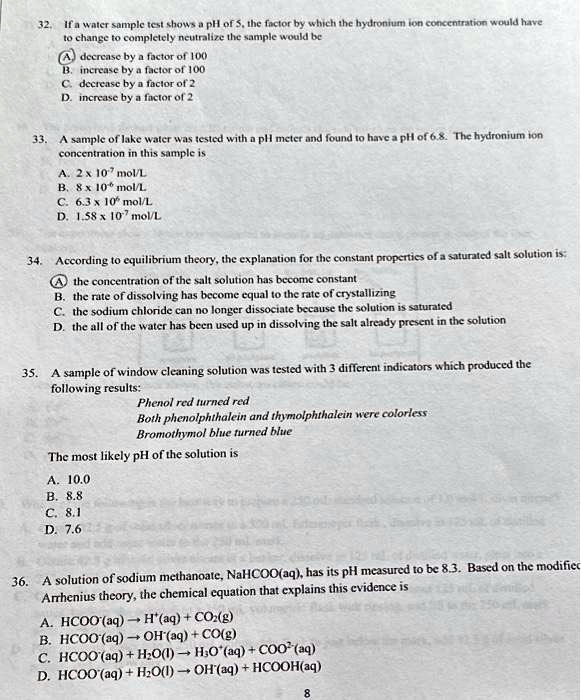
32. If a water sample test shows a pH of 5, the factor by which the hydronium ion concentration would have to change to completely neutralize the sample would be A. decrease by a factor of 100 B. increase by a factor of 100 C. decrease by a factor of 2 D. increase by a factor of 2.
33. A sample of lake water was tested with a pH meter and found to have a pH of 6.8. The hydronium ion concentration in this sample is A. 2x10^-mol/L B. 8x10^-mol/L C. 6.3x10^-mol/L D. 1.58x10^-mol/L.
34. According to equilibrium theory, the explanation for the constant properties of a saturated salt solution is A. the concentration of the salt solution has become constant B. the rate of dissolving has become equal to the rate of crystallizing C. the sodium chloride can no longer dissociate because the solution is saturated D. all of the water has been used up in dissolving the salt already present in the solution.
35. A sample of window cleaning solution was tested with 3 different indicators which produced the following results: Phenol red turned red, both phenolphthalein and thymolphthalein were colorless, and bromothymol blue turned blue. The most likely pH of the solution is A. 10.0 B. 8.8 C. 8.1 D. 7.6.
36. A solution of sodium methanoate, NaHCOO(aq), has its pH measured to be 8.3. Based on the modified Arrhenius theory, the chemical equation that explains this evidence is A. HCOO(aq) + H(aq) + CO(g) B. HCOO(aq) + OH(aq) + CO(g) C. HCOO(aq) + H2O(aq) + COO(aq) D. HCOO(aq) + H2O(aq) + HCOOH(aq).