Texts:
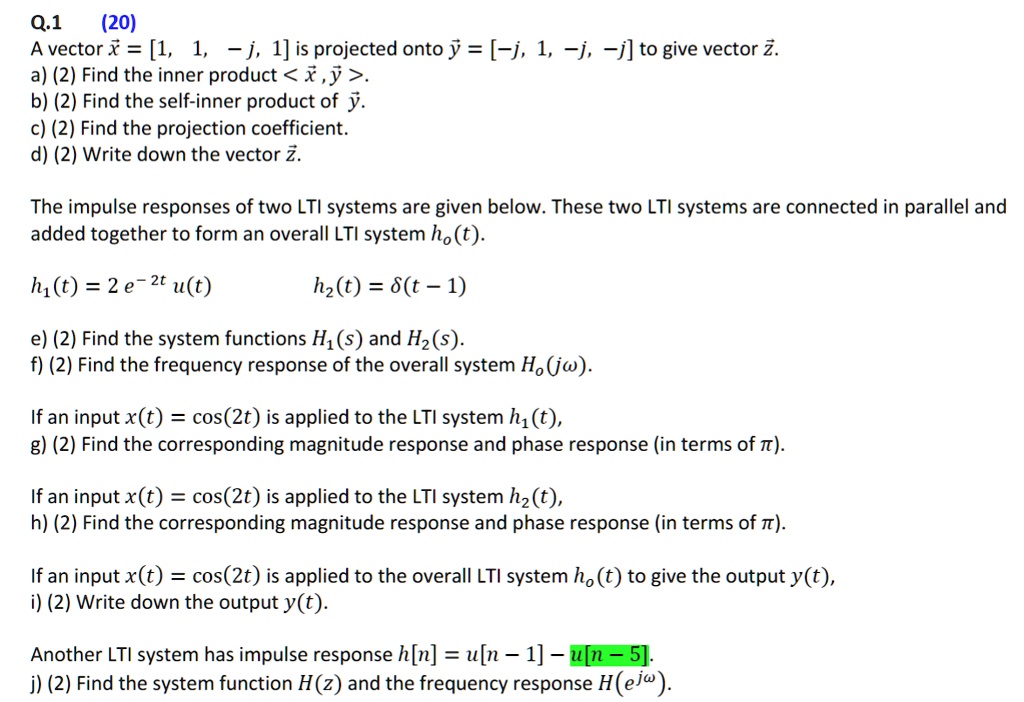
Q.1 (20) A vector x = [1, 1, -i, 1] is projected onto y = [-j, 1, -j, -j] to give vector z.
a) (2) Find the inner product <x, y>.
b) (2) Find the self-inner product of y.
c) (2) Find the projection coefficient.
d) (2) Write down the vector z.
The impulse responses of two LTI systems are given below. These two LTI systems are connected in parallel and added together to form an overall LTI system ho(t).
h1(t) = 2e^(-2t)u(t)
h2(t) = 8(t - 1)
e) (2) Find the system functions H1(s) and H2(s).
f) (2) Find the frequency response of the overall system H(jw).
If an input x(t) = cos(2t) is applied to the LTI system h(t),
g) (2) Find the corresponding magnitude response and phase response (in terms of T).
If an input x(t) = cos(2t) is applied to the LTI system h2(t),
h) (2) Find the corresponding magnitude response and phase response (in terms of t).
If an input x(t) = cos(2t) is applied to the overall LTI system ho(t) to give the output y(t),
i) (2) Write down the output y(t).
Another LTI system has impulse response hn = u[n-1] - u[n-5].
j) (2) Find the system function H(z) and the frequency response H(e^jω).