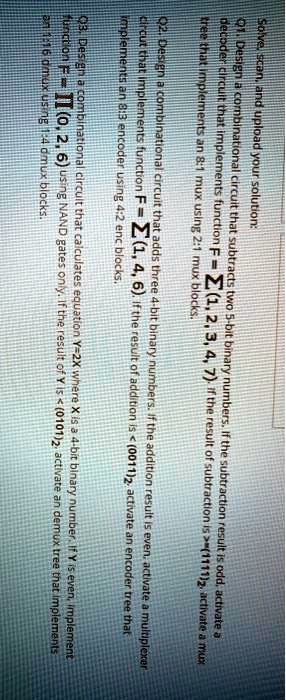
Solve, scan, and upload your solution:
Q1. Design a combinational circuit that subtracts two 5-bit binary numbers. If the subtraction result is odd, activate a
decoder circuit that implements function F = \{1, 2, 3, 4, 7\}. If the result of subtraction is >\(1111\)_2, activate a mux
tree that implements an 8:1 mux using 2:1 mux blocks.
Q2. Design a combinational circuit that adds three 4-bit binary numbers. If the addition result is even, activate a multiplexer
circut that implements function F = \sum (1, 4, 6). If the result of addition is < \(0011\)_2, activate an encoder tree that
implements an 8:3 encoder using 4:2 enc blocks.
Q3. Design a combinational circuit that calculates equation Y=2X where X is a 4-bit binary number. If Y is even, implement
function F = \prod (0, 2, 6) using NAND gates only. If the result of Y is < \(0101\)_2, activate an demux tree that implements
an 1:16 dmux using 1:4 dmux blocks.