1.
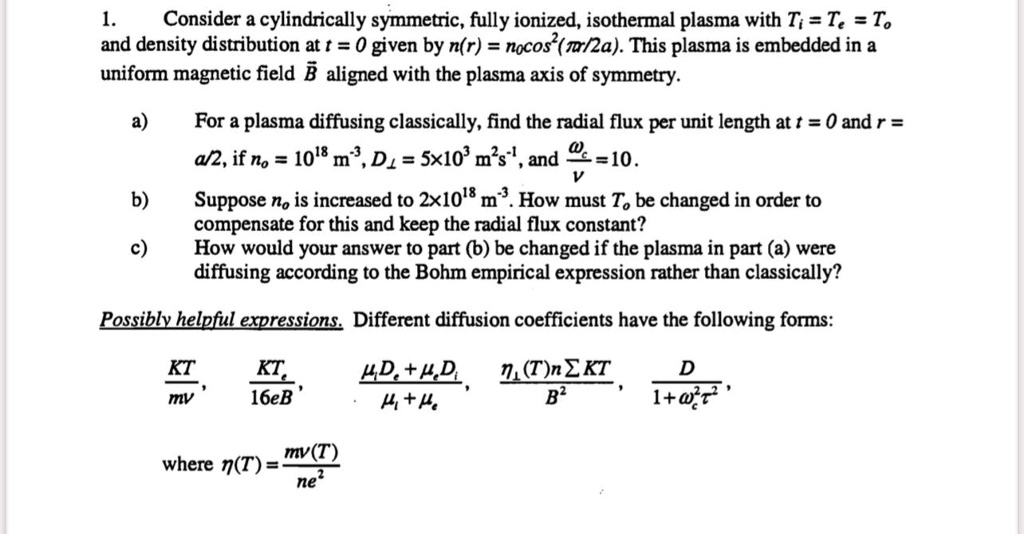
Consider a cylindrically symmetric, fully ionized, isothermal plasma with $T_i = T_e = T_0$
and density distribution at $t = 0$ given by $n(r) = n_0 cos^2(\frac{\pi r}{2a})$. This plasma is embedded in a
uniform magnetic field $\vec{B}$ aligned with the plasma axis of symmetry.
a) For a plasma diffusing classically, find the radial flux per unit length at $t = 0$ and $r =$
$\frac{a}{2}$, if $n_0 = 10^{18} m^{-3}$, $D_\perp = 5 \times 10^3 m^2 s^{-1}$, and $\frac{\omega_c}{\nu} = 10$.
b) Suppose $n_0$ is increased to $2 \times 10^{18} m^{-3}$. How must $T_0$ be changed in order to
compensate for this and keep the radial flux constant?
c) How would your answer to part (b) be changed if the plasma in part (a) were
diffusing according to the Bohm empirical expression rather than classically?
Possibly helpful expressions. Different diffusion coefficients have the following forms:
$\frac{KT}{mv}$, $\frac{KT_e}{16eB}$, $\frac{\mu_\perp D_\perp + \mu_\parallel D_\parallel}{\mu_\perp + \mu_\parallel}$, $\frac{n_\perp (T) n \Sigma KT}{B^2}$, $\frac{D}{1 + \omega_c^2 \tau^2}$,
where $\eta(T) = \frac{mv(T)}{ne^2}$