Ace - AI Tutor
Ask Our Educators
Textbooks
My Library
Flashcards
Scribe - AI Notes
Notes & Exams
Download App
douglas puga

douglas p.

Divider

Questions asked

BEST MATCH

Examples of high risk billing practices which create compliance risks for healthcare organizations include all but which of the following? billing for services that are not medically necessary returned overpayments duplicate billings unbundled procedures

View Answer
divider
BEST MATCH

b) \( J=\iiint_{V}\left(x^{2}+y^{2}\right) d x d y d z, V:\left\{\begin{array}{c}4 \leq x^{2}+y^{2}+z^{2} \leq 16 \\ z \geq 0\end{array}\right. \)

View Answer
divider
BEST MATCH

Find the magnitude and direction angle for the vector. (4, 5) The magnitude for the vector is (Simplify your answer, using radicals as needed. Use integers The direction angle for the vector is (Round to one decimal place as needed.)

View Answer
divider
BEST MATCH

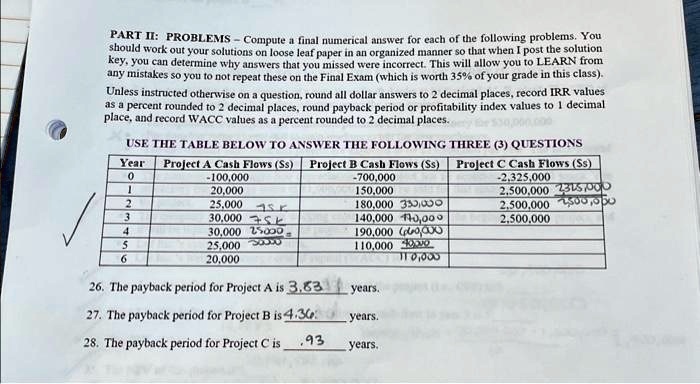
PART II: PROBLEMS Compute a final numerical answer for each of the following problems. You should work out your solutions on loose leaf paper in an organized manner so that when I post the solution key, you can determine why answers that you missed were incorrect. This will allow you to LEARN from any mistakes so you to not repeat these on the Final Exam (which is worth 35% of your grade in this class). Unless instructed otherwise on a question, round all dollar answers to 2 decimal places, record IRR values as a percent rounded to 2 decimal places, round payback period or profitability index values to 1 decimal place, and record WACC values as a percent rounded to 2 decimal places. USE THE TABLE BELOW TO ANSWER THE FOLLOWING THREE (3) QUESTIONS Year Project A Cash Flows (Ss) Project B Cash Flows (Ss) Project C Cash Flows (Ss) 0 -100,000 -700,000 -2,325,000 1 20,000 150,000 2,500,000 2 25,000 180,000 2,500,000 3 30,000 140,000 2,500,000 4 30,000 190,000 5 25,000 110,000 6 20,000 110,000 26. The payback period for Project A is 3.83 years. 27. The payback period for Project B is 4.30 years. 28. The payback period for Project C is .93 years.
View Answer
divider
BEST MATCH

Coupled to the drain of the amplifier. (a) Draw the schematic for the amplifier system. (b) Calculate the voltage gain of the system. = 1118 V1V

View Answer
divider
BEST MATCH

You solution shall include two parts: (a). Show the derivation of the linear equations to solve the problem. You can either write on paper and upload a scanned copy or type in MS word. -- 4 pt (b). M file that defines coefficient matrix, solve the equations (using both methods we discussed in the lecture), and print out the internal force for each member. -- 6 pt G H 5 kN F14 F10 F17 F15 F13 F11 F 6 m F9 F8 F F18 F16 F12 F7 5 kN E 8 m D 8 m C 8 m F 15 kN 15 kN F6 6 m F5 F4 K 5 kN B F3 F1 6 m F2 A Figure P3.2 Truss structure for Project 3.2. Project 3.2 For the truss structure shown in Figure P3.2 write a MATLAB program that will determine the internal forces in the structural members by the method described in Example 3.3. Print out the reactions, the coefficient matrix, the members' internal forces, and a check on the solution.

View Answer
divider
BEST MATCH

The wheel in the figure has two fixed cylinders that rotate together. One with an inside radius of $r_i = 0.7$ m and another with an outside radius of $r_o = 1.4$ m. The wheel rolls without slippage on the flat plate that is in contact with the outside cylinder as shown in the figure If the velocity of the center is $v_c = 0.8$ m/s (constant) to the right, a) Calculate the angular velocity $\omega$ of the wheel. b) Find the velocity of point B, $v_B$. c) Find the velocity of point G, $v_G$. d) Find the velocity of point F, $v_F$. e) Find the velocity of point N, $v_N$. f) Find the acceleration of point N, $a_N$. B G F N Type the answers in the written answer textbox in the online test and email photos of your handwritten solution and image of your student ID card to the instructor at: forget to write your name and id on every page of your sheets. In your email subject field, type "Test 2" followed by "your name" and "your student id". Caution!!! $\omega =$ $v_B =$ $v_G =$ $v_F =$ $v_N =$ $a_N =$ Answers Backward movement is disabled on this test. If you leave this page to view the next problem, you will not be able to come back to work on this problem. Do not leave this problem before you enter the final answers in the textbox.

View Answer
divider
BEST MATCH

For the matrices $Q = \begin{bmatrix} q_1^2 & 0\\ 0 & q_2^2 \end{bmatrix}$, $R = 1$ (a) With $x_0 = 0$ find the gains the LQ gains. (b) Kalman's robustness theorem asserts that a linear state-variable feedback control law is "robust" (as defined in Problem 5, below) if it is LQ optimum for some positive-semidefinite performance matrix Q. Is the control law obtained in Problem 1(a) robust? Explain your reasoning. $A = \begin{bmatrix} 0 & 1\\ 4 & 0 \end{bmatrix}$ $b = \begin{bmatrix} 0\\ 1 \end{bmatrix}$

View Answer
divider
BEST MATCH

Given: m || a, t || h Write C if the given pair of angles are congruent (s) and S if the given pair of angles are supplementary on the space provided before each item number. 6. \angle1 and \angle2 7. \angle2 and \angle3 8. \angle3 and \angle4 9. \angle3 and \angle5 10. \angle1 and \angle5

View Answer
divider
BEST MATCH

k 1: ctions: Find the volume. Use the formula V = l x w x h. Don't forget the unit 1. 1 cm 1 cm 5 cm Answer:

View Answer
divider