Task One:
You're creating a massless device that is meant to keep objects floating in space separate from each other. Your first goal is to separate a thin,
uniformly dense rod of length L meters and mass M kilograms from a particle of mass m kilograms. Your device will keep the particle a fixed
initial distance D_(0) meters from the closest point on the rod, and the rod will line up perfectly, extending away from the particle.
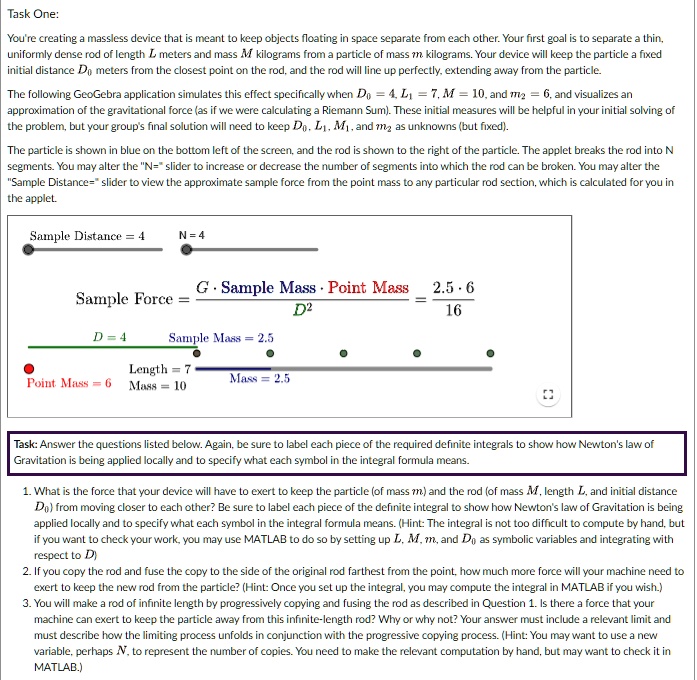
The following GeoGebra application simulates this effect specifically when D_(0)=4,L_(1)=7,M=10, and m_(2)=6, and visualizes an
approximation of the gravitational force (as if we were calculating a Riemann Sum). These initial measures will be helpful in your initial solving of
the problem, but your group's final solution will need to keep D_(0),L_(1),M_(1), and m_(2) as unknowns (but fixed).
The particle is shown in blue on the bottom left of the screen, and the rod is shown to the right of the particle. The applet breaks the rod into N
segments. You may alter the "N=" slider to increase or decrease the number of segments into which the rod can be broken. You may alter the
"Sample Distance=" slider to view the approximate sample force from the point mass to any particular rod section, which is calculated for you in
the annlet
Task: Answer the questions listed below. Again, be sure to label each piece of the required definite integrals to show how Newton's law of
Gravitation is being applied locally and to specify what each symbol in the integral formula means.
What is the force that your device will have to exert to keep the particle (of mass m ) and the rod (of mass M, length L, and initial distance
D_(0) ) from moving closer to each other? Be sure to label each piece of the definite integral to show how Newton's law of Gravitation is being
applied locally and to specify what each symbol in the integral formula means. (Hint: The integral is not too difficult to compute by hand, but
if you want to check your work, you may use MATLAB to do so by setting up L,M,m, and D_(0) as symbolic variables and integrating with
respect to D )
If you copy the rod and fuse the copy to the side of the original rod farthest from the point, how much more force will your machine need to
exert to keep the new rod from the particle? (Hint: Once you set up the integral, you may compute the integral in MATLAB if you wish.)
You will make a rod of infinite length by progressively copying and fusing the rod as described in Question 1. Is there a force that your
machine can exert to keep the particle away from this infinite-length rod? Why or why not? Your answer must include a relevant limit and
must describe how the limiting process unfolds in conjunction with the progressive copying process. (Hint: You may want to use a new
variable, perhaps N, to represent the number of copies. You need to make the relevant computation by hand, but may want to check it in
MATLAB.)
Task One:
uniformly dense rod of length L meters and mass M kilograms from a particle of mass m kilograms. Your device will keep the particle a fixed initial distance Do meters from the closest point on the rod, and the rod will line up perfectly, extending away from the particle.
The following GeoGebra application simulates this effect specifically when D = 4, L = 7, M = 10, and m2 = 6, and visualizes an approximation of the gravitational force (as if we were calculating a Riemann Sum). These initial measures will be helpful in your initial solving of the problem, but your group's final solution will need to keep Do, 1, M1, and m2 as unknowns (but fixed).
The particle is shown in blue on the bottom left of the screen, and the rod is shown to the right of the particle. The applet breaks the rod into N segments. You may alter the N= slider to increase or decrease the number of segments into which the rod can be broken. You may alter the Sample Distance= slider to view the approximate sample force from the point mass to any particular rod section, which is calculated for you in the applet.
Sample Distance = 4
N= 4
G. Sample MassPoint Mass Sample Force = D2
2.5.6 16
D = 4
Sample Mass = 2.5
Length = 7 Point Mass = 6 Mass =10
Mass = 2.5
Task: Answer the questions listed below. Again, be sure to label each piece of the required definite integrals to show how Newton's law of Gravitation is being applied locally and to specify what each symbol in the integral formula means.
1. What is the force that your device will have to exert to keep the particle (of mass m) and the rod (of mass M, length L, and initial distance Do) from moving closer to each other? Be sure to label each piece of the definite integral to show how Newton's law of Gravitation is being applied locally and to specify what each symbol in the integral formula means. (Hint: The integral is not too difficult to compute by hand, but if you want to check your work, you may use MATLAB to do so by setting up L, M, n, and Dg as symbolic variables and integrating with respect to D) 2. If you copy the rod and fuse the copy to the side of the original rod farthest from the point, how much more force will your machine need to
3. You will make a rod of infinite length by progressively copying and fusing the rod as described in Question 1. Is there a force that your machine can exert to keep the particle away from this infinite-length rod? Why or why not? Your answer must include a relevant limit and must describe how the limiting process unfolds in conjunction with the progressive copying process. (Hint: You may want to use a new variable, perhaps N, to represent the number of copies. You need to make the relevant computation by hand, but may want to check it in MATLAB.)