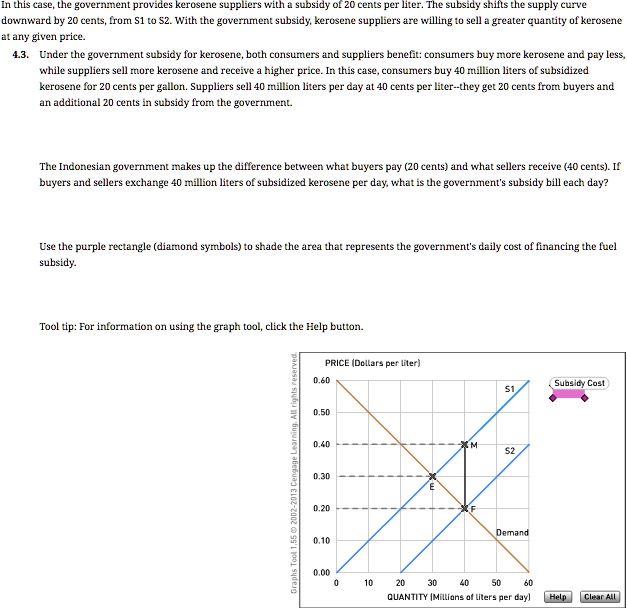
In this case, the government provides kerosene suppliers with a subsidy of 20 cents per liter. The subsidy shifts the supply curve downward by 20 cents, from S1 to S2. With the government subsidy, kerosene suppliers are willing to sell a greater quantity of kerosene at any given price.
4.3. Under the government subsidy for kerosene, both consumers and suppliers benefit: consumers buy more kerosene and pay less, while suppliers sell more kerosene and receive a higher price. In this case, consumers buy 40 million liters of subsidized kerosene for 20 cents per gallon. Suppliers sell 40 million liters per day at 40 cents per liter--they get 20 cents from buyers and an additional 20 cents in subsidy from the government.
The Indonesian government makes up the difference between what buyers pay (20 cents) and what sellers receive (40 cents). If buyers and sellers exchange 40 million liters of subsidized kerosene per day, what is the government's subsidy bill each day?
Use the purple rectangle (diamond symbols) to shade the area that represents the government's daily cost of financing the fuel subsidy.
Tool tip: For information on using the graph tool, click the Help button.
PRICE (Dollars per liter)
0.60
Subsidy Cost
S1
0.50
0.40
M
S2
0.30
E
0.20
F
Graphs Tool 1.55© 2002-2013 Cengage Learning. All rights reserved.
Demand
0.10
0.00
10 20 30 40 50 60
QUANTITY (Millions of liters per day)
Help Clear All