Ace - AI Tutor
Ask Our Educators
Textbooks
My Library
Flashcards
Scribe - AI Notes
Notes & Exams
Download App
dylan waters

dylan w.

Divider

Questions asked

BEST MATCH

6. To explain why this trend occurs, it might be useful to examine elements at both ends of group 1. Draw a Bohr model for lithium (Li) and cesium (Cs). 7. Look at the drawings above, which atom has more attraction for its outer electron(s)? (think about the factors that affect attraction between charged particles) This is difficult to determine from these drawings because based on the factors that affect strength of attraction between charged particles (discussed in our notes), lithium has more attraction based on one of the factors and cesium has more attraction based on another factor, specifically: Lithium has a smaller distance (2 shells for Li vs 6 shells for Cs) between the nucleus and the valence electron and with smaller distance, comes greater attraction between charged particles BUT Cesium has a greater nuclear charge (55 protons in the nucleus for Cs vs 3 protons in the nucleus for Li) and with more positive charge in the nucleus, comes more attraction between the electron and the nucleus. To resolve this contradiction, we will use core charge to more clearly see which factor is most important. Core charge is a way of thinking about the net attraction an electron experiences for the nucleus AFTER considering that other electrons would also be repelling that electron (like charges repel and therefore electrons repel each other). Core charge = atomic number - core electrons Li: Core charge = 3 - 2 = +1 Cs: Core charge = 55 - 54 = +1 This means that the valence electron of lithium experiences the pull of only 1 proton (core charge = +1) in the nucleus and cesium's valence electron also experiences the pull of only 1 proton (core charge = +1) in the nucleus. Therefore we can redraw the models like this:

View Answer
divider
BEST MATCH

before proceeding to the next one. This quiz has 10 questions and is worth 10 points. Question 1 5 pts The type of physiological demand placed [Choose ] on the body will dictate the specific adaptation that will occur. Progression Reversibility Overload An above-normal stress or load applied t Specificity a muscle to elicit an enhanced training Individual Differences response. To continue seeing gains and [Choose ] improvements from and exercise program the intensity of the exercises must gradually become increasingly more challenging. Once initial neuromuscular adaptations [Choose ] have occurred, without regular strength training muscles ma atrophy and become weaker. Individuals respond differently and may adapt well or may be a "low-responder" to and exercised stimulus [Choose ] Next? No new data to save. Last checked at 8:59pm Submit Quiz MacBook Pro

View Answer
divider
BEST MATCH

Draw a free-body diagram of the link on the right shown below. The links have the same length, L, and mass, m. They are connected by a frictionless hinge. Each is at a 45-degree angle. Gravity points down.

View Answer
divider
BEST MATCH

What is a duty? Question 45 options: Something that pertains strictly to human rights. A cost-benefit analysis. A type of hat worn by ethicists. A basic rule of how to conduct oneself.

View Answer
divider
BEST MATCH

QUESTION 12 Jae-Joon is preparing for his first graded speech in his communication class, and he is intensely nervous about the assignment. What is he experiencing? a. Speech anxiety b. Self-fulfilling prophecy c. High anxiety d. Stage fright

View Answer
divider
BEST MATCH

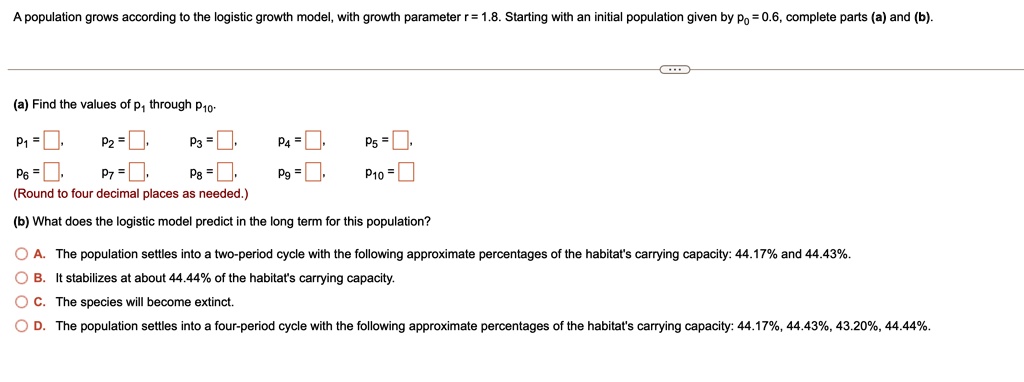
A population grows according to the logistic growth model, with growth parameter r = 1.8. Starting with an initial population given by $p_0$ = 0.6, complete parts (a) and (b). (a) Find the values of $p_1$ through $p_{10}$. $p_1$ = $oxed{ }$, $p_2$ = $oxed{ }$, $p_3$ = $oxed{ }$ $p_6$ = $oxed{ }$, $p_7$ = $oxed{ }$, $p_8$ = $oxed{ }$ $p_4$ = $oxed{ }$, $p_5$ = $oxed{ }$ $p_9$ = $oxed{ }$, $p_{10}$ = $oxed{ }$ (Round to four decimal places as needed.) (b) What does the logistic model predict in the long term for this population? A. The population settles into a two-period cycle with the following approximate percentages of the habitat's carrying capacity: 44.17% and 44.43%. B. It stabilizes at about 44.44% of the habitat's carrying capacity. C. The species will become extinct. D. The population settles into a four-period cycle with the following approximate percentages of the habitat's carrying capacity: 44.17%, 44.43%, 43.20%, 44.44%.
View Answer
divider
BEST MATCH

5. The following is a network topology, each node represents a router and numbers on each edge means distance between any two routers. Please apply Dijkstra's Shortest Path Algorithm to find the shortest routing path between node s and t Show your solutions step by step and provide the shortest route as well as total distance. 2 9 S 24 18 14 6 30 4 11 15 5 5 20 16 7 44 3 19 t

View Answer
divider
BEST MATCH

3. The reaction between hydrochloric acid and barium hydroxide has a heat of neutralization of -118 kJ per mole of barium chloride. In a coffee-cup calorimeter, 100.0 mL of 0.500 M hydrochloric acid is mixed with 300.0 mL of 0.100 M barium hydroxide, both at 25.0°C. After the reaction, the final mixture has a mass of 400.0 g and has a specific heat capacity of 4.184 J/g°C. Calculate the final temperature of the mixture. 4. A 0.1964 g sample of quinone ($C_6H_4O_2$) is burned in a bomb calorimeter that has a heat capacity of 1.56 kJ/°C, and the temperature of the calorimeter rises from 21.0°C to 24.2°C. Calculate the heat of combustion of quinone in kJ per gram of quinone. 5. Using your answer from question 4, calculate the amount of heat released or absorbed when the given amounts of quinone are burned. (a) 3.65 grams of quinone (b) 75.0 mL of quinone (density = 1.256 g/mL)

View Answer
divider
BEST MATCH

3. Write a Matlab Program to demonstrate the elliptical animation in x and y coordinates. The below figure 1 shows the expected result of animation which should be in motion and also record each frame data and store as an video in MP4 format. Figure 1

View Answer
divider
BEST MATCH

8. A particular design of a voltage regulator is shown below. Diodes D1 and D2 are 10 mA units; that is, each has a voltage drop of 0.7 V at a current of 10 mA. Each has n=1. a. What is the regulator output voltage V0 with the 150 ? load connected? b. Find V0 no load.

View Answer
divider