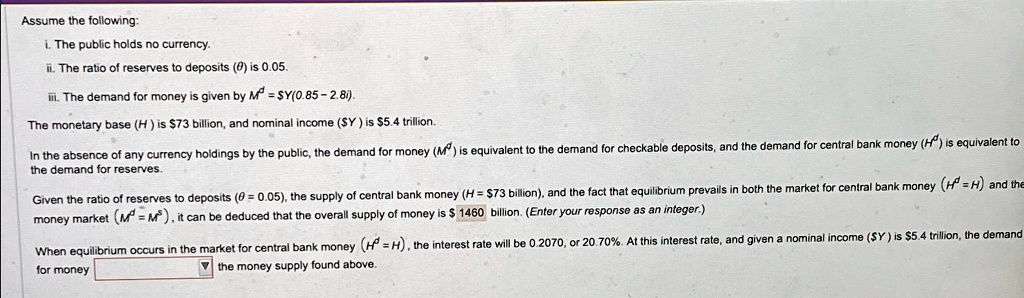
Assume the following:
i. The public holds no currency.
ii. The ratio of reserves to deposits ( heta) is 0.05.
iii. The demand for money is given by M^(d) = $Y(0.85 - 2.8i).
The monetary base (H) is $73 billion, and nominal income ($Y) is $5.4 trillion.
In the absence of any currency holdings by the public, the demand for money (M^(d)) is equivalent to the demand for checkable deposits, and the demand for central bank money (H^(d)) is equivalent to the demand for reserves.
Given the ratio of reserves to deposits ( heta) = 0.05, the supply of central bank money billion), and the fact that equilibrium prevails in both the market for central bank money (H^(d)) = (H) and the money market (M^(d)) = (M^(s)), it can be deduced that the overall supply of money is $1460 billion. (Enter your response as an integer.)
When equilibrium occurs in the market for central bank money (), the interest rate will be 0.2070, or 20.70%. At this interest rate, and given a nominal income ($Y) is $5.4 trillion, the demand for money the money supply found above.