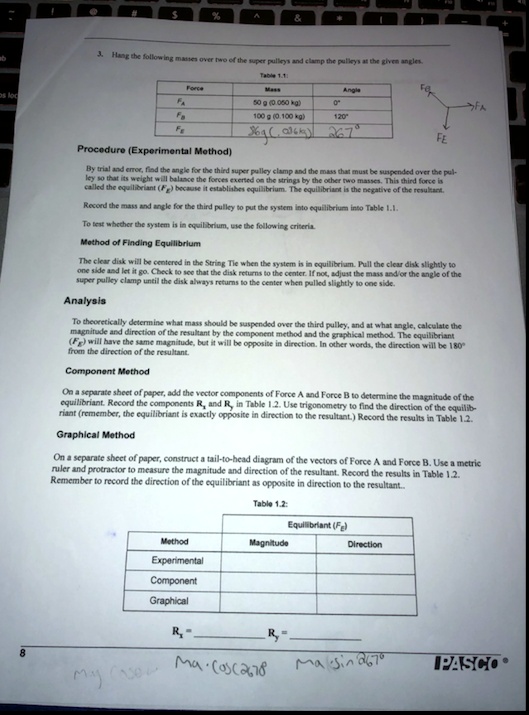
Please show how to find the Equilibriant Fe magnitude and direction with the three different methods and the resultant Rx and Ry.
Fa = 50 grams at 0 degrees (Set by lab)
Fb = 100 grams at 120 degrees (Set by lab)
Fe = 86 grams at 267 degrees. (Trial and error by me)
Hang the following table:
Table 1.1: Force Mass Angle
FO FA 50 g (0.050 kg)
Fa 100 g (0.100 kg) 120°
Fs 267°
FE
Procedure (Experimental Method)
By trial and error, find the angle for the third super pulley clamp and the mass that must be suspended over the pulley so that its weight will balance the forces exerted on the strings by the other two masses. This third force is called the equilibriant F because it establishes equilibrium. The equilibriant is the negative of the resultant. Record the mass and angle for the third pulley to put the system into equilibrium into Table 1.1.
To test whether the system is in equilibrium, use the following criteria:
Method of Finding Equilibrium
The clear disk will be centered in the String Tie when the system is in equilibrium. Pull the clear disk slightly to one side and let it go. Check to see that the disk returns to the center. If not, adjust the mass and/or the angle of the super pulley clamp until the disk always returns to the center when pulled slightly to one side.
Analysis
To theoretically determine what mass should be suspended over the third pulley, and at what angle, calculate the magnitude and direction of the resultant by the component method and the graphical method. The equilibriant F will have the same magnitude, but it will be opposite in direction. In other words, the direction will be 180 degrees from the direction of the resultant.
Component Method
On a separate sheet of paper, add the vector components of Force A and Force B to determine the magnitude of the equilibriant. Record the components Rx and Ry in Table 1.2. Use trigonometry to find the direction of the equilibriant (remember, the equilibriant is exactly opposite in direction to the resultant). Record the results in Table 1.2.
Graphical Method
On a separate sheet of paper, construct a head-to-tail diagram of the vectors of Force A and Force B. Use a metric ruler and protractor to measure the magnitude and direction of the resultant. Record the results in Table 1.2. Remember to record the direction of the equilibriant as opposite in direction to the resultant.
Table 1.2: Equilibriant (Fe) Method Magnitude Direction
Experimental
Component
Graphical
Rx
Ry