Ace - AI Tutor
Ask Our Educators
Textbooks
My Library
Flashcards
Scribe - AI Notes
Notes & Exams
Download App
eduardo byrd

eduardo b.

Divider

Questions asked

BEST MATCH

Which of the following is supported by empirical evidence? A The majority of purely psychological problems are not helped by medications for treatment B Most biologically based disorders require medications for treatment C Most persons who are prescribed medications will be compliant with the medication regimen D Both A and B

View Answer
divider
BEST MATCH

End providers are treating a 48-year-old with chest pain and dizziness who appears to have been drinking heavily. You believe the patient is just trying to get attention. Choose the MOST appropriate technique for moving the patient from a bedroom to the living room downstairs.

View Answer
divider
BEST MATCH

Which statements are true? A reducing agent gains electrons. An oxidizing agent gains electrons. The oxidation number for Hg(l) is 0. Zn$^{2+}$ is formed from the oxidation of Zn(s). The oxidation number for Cu(s) is +2. Na$^+$ is formed from the reduction of Na(s).

View Answer
divider
BEST MATCH

Under increasing opportunity cost, the equilibrium international TOT 7. a. represent the rate at which good X and good Y exchange in the international market. b. must simultaneously clear the markets for goods X and Y. c. must lie between the two countries autarky price ratios in order to yield benefit from trade for both countries. d. determine how the gains from trade are divided between the two countries. e. are correctly described by all of the above.

View Answer
divider
BEST MATCH

Where is \beta -carotene expected to show up on the TLC plate and why?

View Answer
divider
BEST MATCH

A simple regression analysis with 20 observations would yield degrees of freedom error and degrees of freedom total.

View Answer
divider
BEST MATCH

Which of the following is NOT part of the economic solution to lowering the amount of carbon dioxide pollution being added to our atmosphere? all of these are part of the economic solution decrease the supply of the technologies and products that are polluting the air decrease the demand for the technologies and products that are polluting the air create legislation that prevents companies from polluting the air identify the sources of the most air pollution

View Answer
divider
BEST MATCH

/Student/PlayerPractice.aspx?chapterld \( =9 \& \) sld \( =18 \) objectiveld \( =2 \& \) single=true\&centerwin=yes iberal Arts Summer 2024 Monica Hernandez \( \quad 06 / 30 / 241: 51 \mathrm{PM} \) Equations Question 3, 7.1.v-2 2 correct Points: 0 of 1 Close Fill in the blanks below. The \( \qquad \) of the graph of a linear equation is the point where the graph crosses the \( x \)-axis. The \( \qquad \) is the point where the graph crosses the \( y \)-axis. The \( \square \) of the graph of a linear equation is the point where the graph crosses the \( x \)-axis. The \( \square \) is the point where the graph crosses the \( y \)-axis. Calculator Ask my instructor Clear all 7.3 Modeline with Ouadratic Equations

View Answer
divider
BEST MATCH

Suppose that the functions $r$ and $s$ are defined for all real numbers $x$ as follows. $r(x) = x + 2$ $s(x) = 3x + 3$ Write the expressions for $(r - s)(x)$ and $(r + s)(x)$ and evaluate $(r \cdot s)(-1)$. $(r - s)(x) = (r + s)(x) = (r \cdot s)(-1) = $

View Answer
divider
BEST MATCH

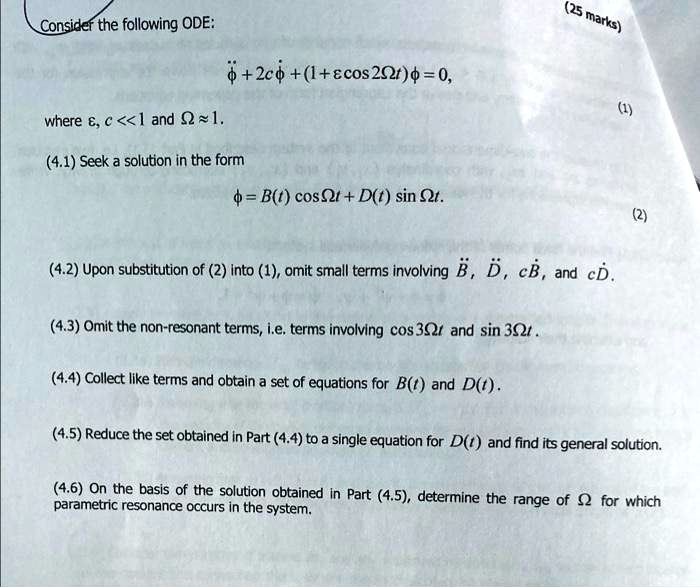
Consider the following ODE: $\ddot{\phi} + 2c\dot{\phi} + (1 + \epsilon \cos 2\Omega t)\phi = 0$, where $\epsilon, c << 1$ and $\Omega \approx 1$. (4.1) Seek a solution in the form $\phi = B(t)\cos\Omega t + D(t)\sin\Omega t$. (4.2) Upon substitution of (2) into (1), omit small terms involving $\ddot{B}$, $\ddot{D}$, $c\dot{B}$, and $c\dot{D}$. (4.3) Omit the non-resonant terms, i.e. terms involving $\cos 3\Omega t$ and $\sin 3\Omega t$. (4.4) Collect like terms and obtain a set of equations for $B(t)$ and $D(t)$. (4.5) Reduce the set obtained in Part (4.4) to a single equation for $D(t)$ and find its general solution. (4.6) On the basis of the solution obtained in Part (4.5), determine the range of $\Omega$ for which parametric resonance occurs in the system.
View Answer
divider