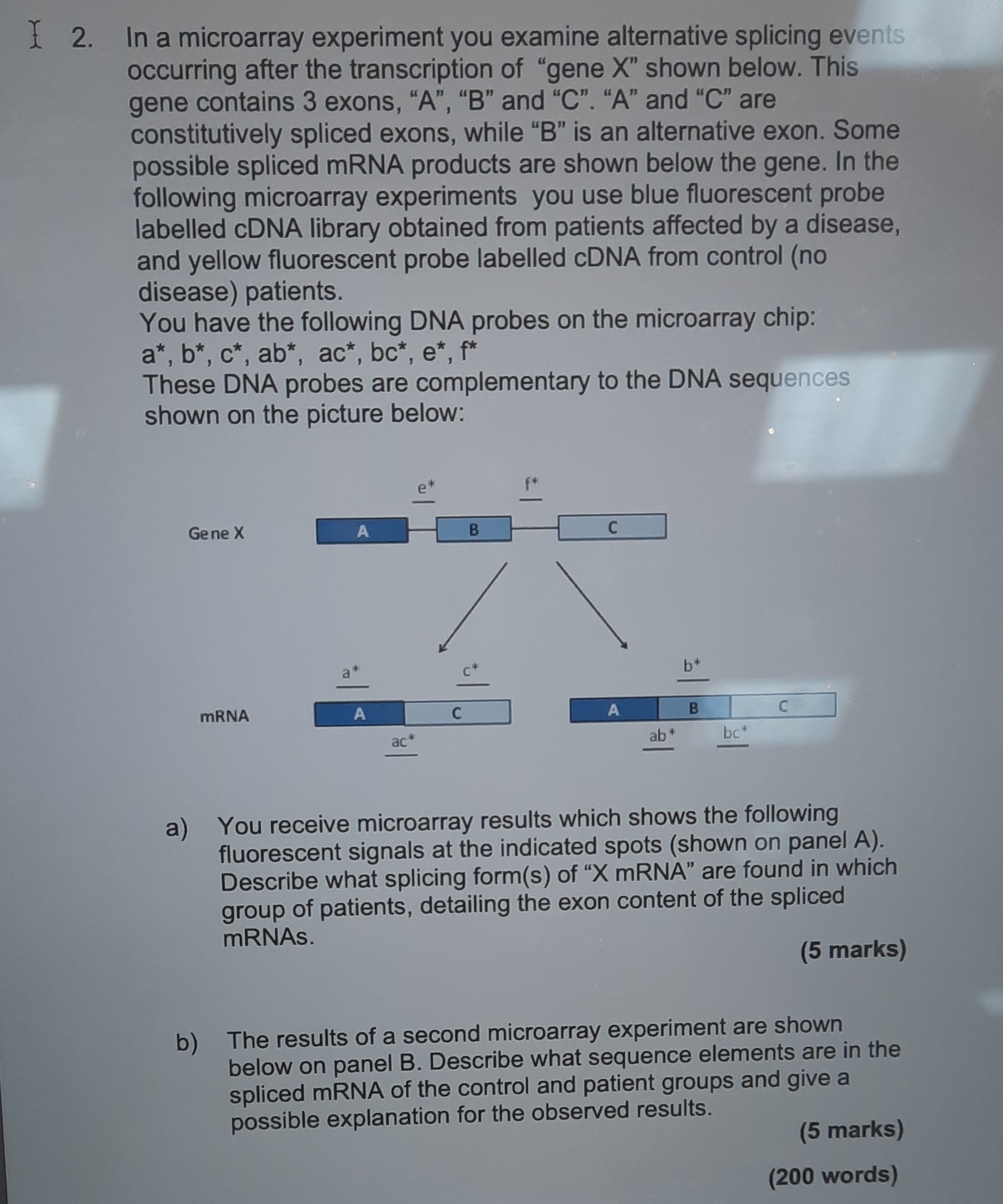
2. In a microarray experiment you examine alternative splicing events occurring after the transcription of "gene \( X \) " shown below. This gene contains 3 exons, " \( A \) ", " \( B \) " and " \( C \) ". " \( A \) " and " \( C \) " are constitutively spliced exons, while " \( \mathrm{B} \) " is an alternative exon. Some possible spliced mRNA products are shown below the gene. In the following microarray experiments you use blue fluorescent probe labelled CDNA library obtained from patients affected by a disease, and yellow fluorescent probe labelled cDNA from control (no disease) patients.
You have the following DNA probes on the microarray chip: \( a^{*}, b^{*}, c^{*}, a b^{*}, a c^{*}, b c^{*}, e^{*}, f^{*} \) These DNA probes are complementary to the DNA sequences shown on the picture below:
a) You receive microarray results which shows the following fluorescent signals at the indicated spots (shown on panel A). Describe what splicing form(s) of "X mRNA" are found in which group of patients, detailing the exon content of the spliced mRNAs.
(5 marks)
b) The results of a second microarray experiment are shown below on panel \( B \). Describe what sequence elements are in the spliced mRNA of the control and patient groups and give a possible explanation for the observed results.
(5 marks)
(200 words)