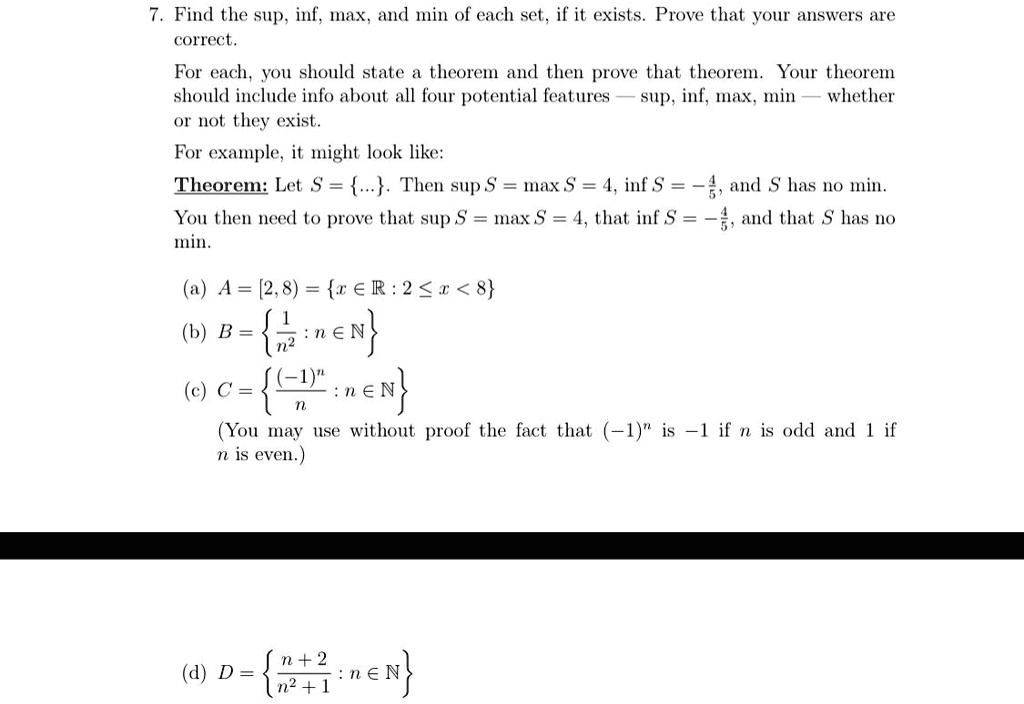
7. Find the sup, inf, max, and min of each set, if it exists. Prove that your answers are
correct.
For each, you should state a theorem and then prove that theorem. Your theorem
should include info about all four potential features — sup, inf, max, min — whether
or not they exist.
For example, it might look like:
Theorem: Let S = {...}. Then sup S = max S = 4, inf S = $-\frac{4}{5}$, and S has no min.
You then need to prove that sup S = max S = 4, that inf S = $-\frac{4}{5}$, and that S has no
min.
(a) A = [2,8) = {$x \in \mathbb{R}$ : 2 $\le$ x < 8}
(b) B = {$\frac{1}{n^2}$ : n $\in \mathbb{N}$}
(c) C = {$\frac{(-1)^n}{n}$ : n $\in \mathbb{N}$}
(You may use without proof the fact that $(-1)^n$ is ?1 if n is odd and 1 if
n is even.)
(d) D = {$\frac{n+2}{n^2+1}$ : n $\in \mathbb{N}$}