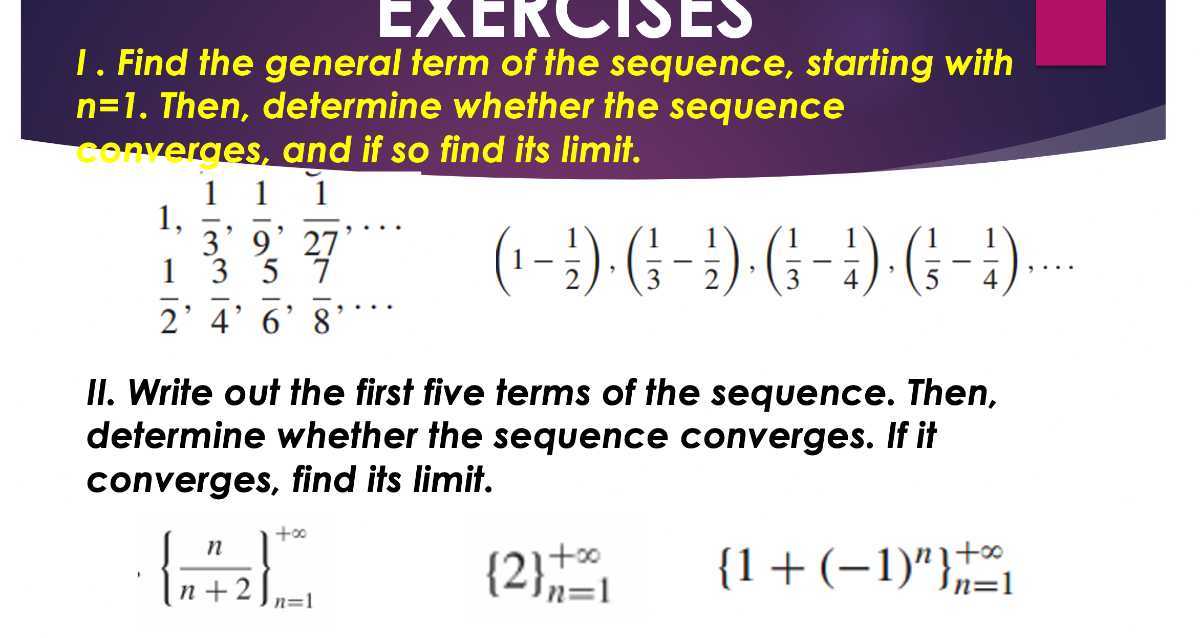
al term of the sequence, starting with \( n=1 \). Then, defermine whether the sequence converges, and if so find its limit.
\[
\begin{array}{l}
1, \frac{1}{3}, \frac{1}{9}, \frac{1}{27}, \ldots \\
\frac{1}{2}, \frac{3}{4}, \frac{5}{6}, \frac{7}{8}, \ldots
\end{array} \quad\left(1-\frac{1}{2}\right),\left(\frac{1}{3}-\frac{1}{2}\right),\left(\frac{1}{3}-\frac{1}{4}\right),\left(\frac{1}{5}-\frac{1}{4}\right), \ldots
\]
II. Write out the first five terms of the sequence. Then, determine whether the sequence converges. If it converges, find its limit.
\[
\left\{\frac{n}{n+2}\right\}_{n=1}^{+\infty} \quad\{2\}_{n=1}^{+\infty} \quad\left\{1+(-1)^{n}\right\}_{n=1}^{+\infty}
\]