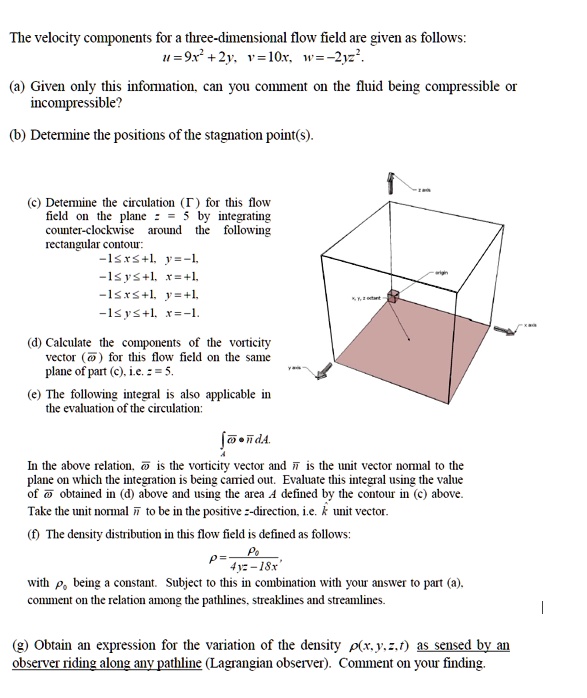
The velocity components for a three-dimensional flow field are given as follows: v = 9x + 2y, v = 10x, w = -2yz.
(a) Given only this information, can you comment on whether the fluid is compressible or incompressible?
(b) Determine the positions of the stagnation point(s).
(c) Determine the circulation (T) for this flow field on the plane = 5 by integrating counter-clockwise around the following rectangular contour: 1x+l, y=1, 1y+1, x=+1, 1x+l, y=+1, -1y+1, x=1.
(d) Calculate the components of the vorticity vector (Ω) for this flow field on the same plane as part (c), i.e. = 5.
(e) The following integral is also applicable in the evaluation of the circulation:
∮ Ω · dA
In the above relation, Ω is the vorticity vector and dA is the unit vector normal to the plane on which the integration is being carried out. Evaluate this integral using the value of Ω obtained in (d) above and using the area A defined by the contour in (c) above. Take the unit normal vector to be in the positive k-direction, i.e. k unit vector.
(f) The density distribution in this flow field is defined as follows: Ï = 4y - 18x, with Ï being a constant. Subject to this, in combination with your answer to part (a), comment on the relation among the pathlines, streaklines, and streamlines.
(g) Obtain an expression for the variation of the density (Ï) as sensed by an observer riding along any pathline (Lagrangian observer). Comment on your findings.