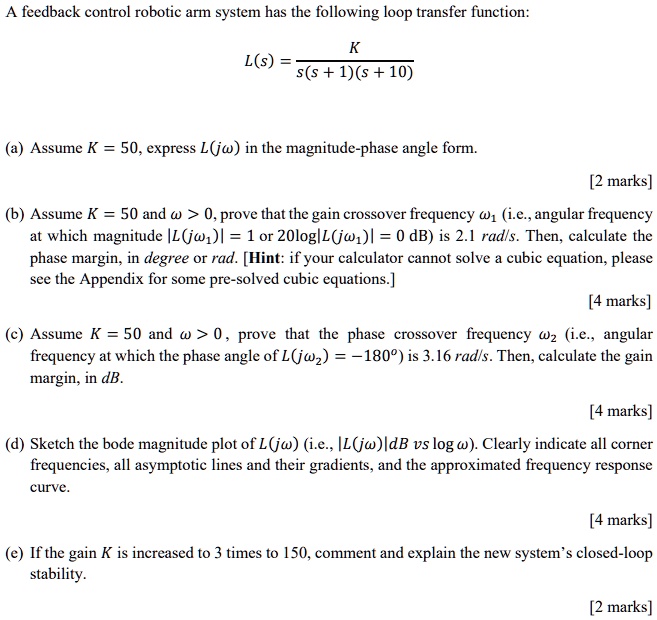
A feedback control robotic arm system has the following loop transfer function:
L(s)=(K)/(s(s+1)(s+10))
(a) Assume K=50, express L(jomega ) in the magnitude-phase angle form.
[2 marks]
(b) Assume K=50 and omega >0, prove that the gain crossover frequency omega _(1) (i.e., angular frequency
at which magnitude |L(jomega _(1))|=1 or 20log|L(jomega _(1))|=0dB ) is 2.1ra(d)/(s). Then, calculate the
phase margin, in degree or rad. [Hint: if your calculator cannot solve a cubic equation, please
see the Appendix for some pre-solved cubic equations.]
[4 marks]
(c) Assume K=50 and omega >0, prove that the phase crossover frequency omega _(2) (i.e., angular
frequency at which the phase angle of {:L(jomega _(2))=-180deg ) is 3.16ra(d)/(s). Then, calculate the gain
margin, in dB.
[4 marks]
(d) Sketch the bode magnitude plot of L(jomega ) (i.e., |L(jomega )|dBvslogomega ). Clearly indicate all corner
frequencies, all asymptotic lines and their gradients, and the approximated frequency response
curve.
[4 marks]
(e) If the gain K is increased to 3 times to 150, comment and explain the new system's closed-loop
stability.