Essential questions: Can we use the conditions for static equilibrium to determine an unknown mass?
Objects remain at rest only when the net force and the net torque are zero. The converse is also true: if an object remains at rest, then you know the net force and the net torque must be zero. The first statement predicts whether an object will remain at rest or begin to move, while the second statement is used to determine unknown forces.
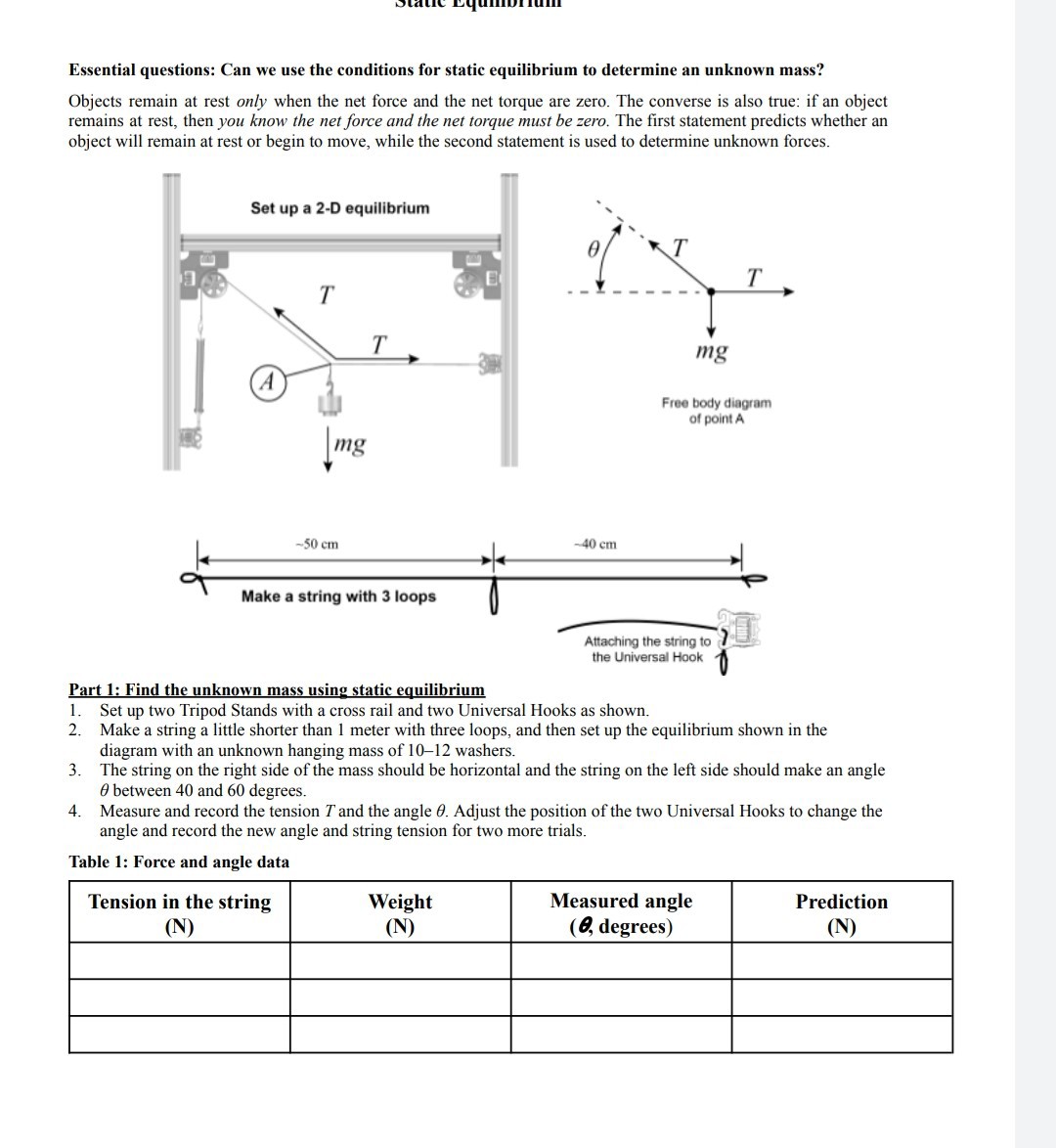
Free body diagram of point \( A \)
Part 1: Find the unknown mass using static equilibrium
1. Set up two Tripod Stands with a cross rail and two Universal Hooks as shown.
2. Make a string a little shorter than 1 meter with three loops, and then set up the equilibrium shown in the diagram with an unknown hanging mass of 10-12 washers.
3. The string on the right side of the mass should be horizontal and the string on the left side should make an angle \( \theta \) between 40 and 60 degrees.
4. Measure and record the tension \( T \) and the angle \( \theta \). Adjust the position of the two Universal Hooks to change the angle and record the new angle and string tension for two more trials.
Table 1: Force and angle data
\begin{tabular}{|c|c|c|c|}
\hline \begin{tabular}{c}
Tension in the string \\
(N)
\end{tabular} & \begin{tabular}{c}
Weight \\
(N)
\end{tabular} & \begin{tabular}{c}
Measured angle \\
\( (\boldsymbol{\theta} \), degrees)
\end{tabular} & \begin{tabular}{c}
Prediction \\
(N)
\end{tabular} \\
\hline & & & \\
\hline & & & \\
\hline & & & \\
\hline
\end{tabular}