Questions asked
Find the LCD. Then convert each expression to an equivalent expression with the denominator equal to the LCD. $$ \frac{6}{(q-4)(q-6)}; \frac{q}{(q-6)(q+3)} $$ Part 1 of 2 The LCD is $$ (q-4)(q-6)(q+3) $$ Part 2 of 2 The equivalent expressions are $$ \frac{\Box}{(q-4)(q-6)(q+3)} $$ and $$ \frac{\Box}{(q-4)(q-6)(q+3)} $$
We recognize today that child abuse or maltreatment is: usually perpetrated by the child's parents. accidental or intentional. rare and sudden. most often the work of strangers with mental disorders.
What are the challenges facing the\financing and delivery of health care services
what type of transmission is this c) In England, there was a situation in which people were finding their milk bottle (left by the milkman) were opened and the cream on top removed before they could bring them inside their house. It started in a small town and then spread rapidly through the country. It was quickly found that birds were opening the containers. The birds doing this would travel in flocks.
The chief role of a/an ____ is to get the opposing parties to communicate again rather than providing a solution or a decision, and cannot impose his or her views on the parties. ? arbitrator ? intermediary ? mediator ? conciliator
Which of the following theories is best illustrated by Meili's discussion of the social determinants of health in chapter 1 of his book? Psychosocial comparison. Materialism. Neomaterialism. Republicanism.
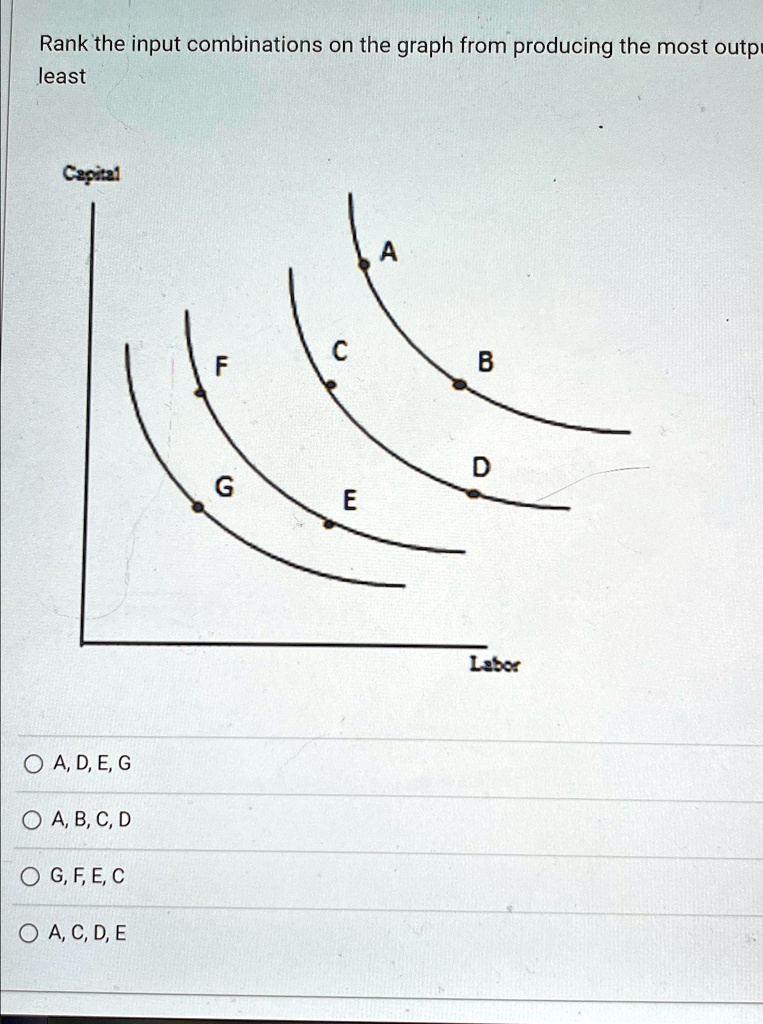
Rank the input combinations on the graph from producing the most output to least Capital A C F B D G E Labor A, D, E, G A, B, C, D G, F, E, C A, C, D, E
ueston11 1pts You start with an inflated balloon with a volume of O.5 m3.While keeping the balloon at atmospheric pressure, you heat the balloon from 11'C to 32'C.How much work does the air perform on the balloon?
q"_s $T_1$ $T_2$ $T_3$ $T_4$ $T_5$ $T_6$ $T_7$ $T_8$ $T_9$ $T_{10}$ $T_{11}$ $T_{12}$ $T_{13}$ $T_{14}$ $T_{15}$ $T_{16}$ $T_{17}$ $T_{18}$ $T_{19}$ $T_{20}$ $T_{21}$ $T_{22}$ $T_{23}$ $T_{24}$ $T_{25}$ $\Delta x = \Delta y = 40 \text{ mm}$ $T_{\infty}, h$ $q"_s$ $T_1$ $T_2$ $T_3$ $T_4$ $T_5$ $T_6$ $T_7$ $T_8$ $T_9$ $T_{10}$ $T_{11}$ $T_{12}$ $T_{13}$ $T_{14}$ $T_{15}$ $T_{16}$ $T_{17}$ $T_{18}$ $T_{19}$ $T_{20}$ $T_{21}$ $T_{22}$ $T_{23}$ $T_{24}$ $T_{25}$ $T_{26}$ $T_{27}$ $T_{28}$ $\Delta x = \Delta y = 40 \text{ mm}$ $T_{\infty}, h$ $q"_s = 5 \text{ W/cm}^2,$ $k = 200 \text{ W/m-K},$ $T_{\infty} = 30^\circ \text{C},$ $h = 200 \text{ W/m}^2\text{-K}$ (a) (b)
Welcome back from your expedition into the cells! Let's see if you paid attention to the molecules that are involved in the smooth muscle contraction. Which neurotransmitter is released from the parasympathetic ganglion? a) Acetylcholine b) Norepinephrine c) Noradrenaline d) Epinephrine