Ace - AI Tutor
Ask Our Educators
Textbooks
My Library
Flashcards
Scribe - AI Notes
Notes & Exams
Download App
elena rose

elena r.

Divider

Questions asked

BEST MATCH

4. Quantity demanded for a cell phone falls by 5% when its price rises by 2%. Calculate the price elasticity of demand for the cell phone

View Answer
divider
BEST MATCH

Question 2 5 pts If the equilibrium price increases and the equilibrium output increases then what must have happened. None of the answers provided are correct because an increase in output would not happen if price increases. Supply increased Supply decreased Demand increased Demand decreased

View Answer
divider
BEST MATCH

Create the illustrated model using SolidWorks. Enter the total mass of the part in grams below. Given: A = 0 19 Material: Gray Cast Iron Density: 0.0072 g/mm$^3$ Units: MMGS NOTE: ALL HOLES ARE THROUGH HOLES

View Answer
divider
BEST MATCH

Which of these statements on kidney structure and function is incorrect? a) the renal medulla is composed of renal pyramids; separated by renal columns b) the renal pyramids empty urine into the calyces that drain into the renal pelvis c) the glomerular capsule and the proximal and distal convoluted tubules are located in the cortex; and nephron loop is located in the renal medulla d) glomerular blood is drained by an efferent arteriole; which delivers blood to peritubular capillaries. e) none of them

View Answer
divider
BEST MATCH

1 1 point Based on economic research, the neutrality of money always holds mostly holds in the short-run, but not in the long-run does not hold at all mostly holds in the long-run, but not the short-run

View Answer
divider
BEST MATCH

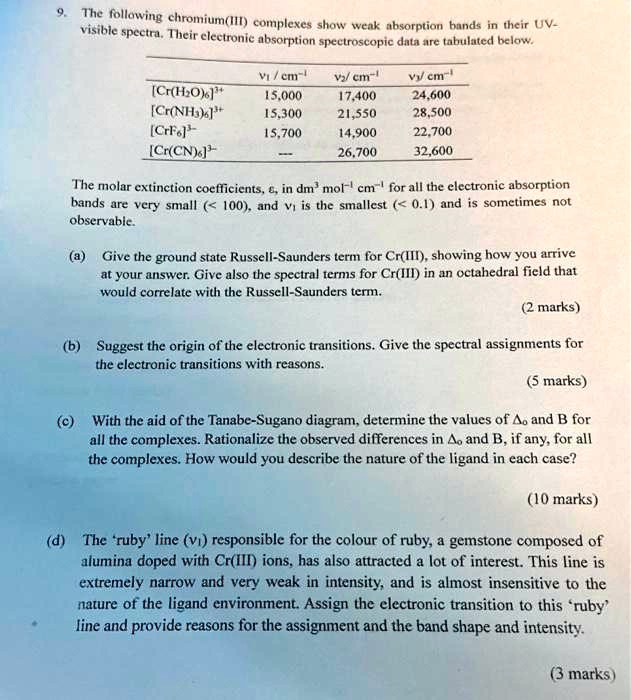
v/cm- v/cm- 15,000 17,400 15,300 21,550 15,700 14,900 26,700 v/cm- 24,600 28,500 22,700 32,600 [Cr(H2O)6] [Cr(NH3)6] [Cr(F)6] [Cr(CN)6] observable a) Give the ground state Russell-Saunders term for Cr(II), showing how you arrive at your answer. Give also the spectral terms for Cr(III) in an octahedral field that would correlate with the Russell-Saunders term. (2 marks) b) Suggest the origin of the electronic transitions. Give the spectral assignments for the electronic transitions with reasons. (5 marks) c) With the aid of the Tanabe-Sugano diagram, determine the values of D and B for all the complexes. Rationalize the observed differences in D and B, if any, for all the complexes. How would you describe the nature of the ligand in each case? (10 marks) d) The ruby line responsible for the color of ruby, a gemstone composed of alumina doped with Cr(III) ions, has also attracted a lot of interest. This line is extremely narrow and very weak in intensity, and is almost insensitive to the nature of the ligand environment. Assign the electronic transition to this ruby line and provide reasons for the assignment and the band shape and intensity. (3 marks)
View Answer
divider
BEST MATCH

The graph shows the titration curves of a strong acid and a weak acid. Estimate the $pK_a$ of the weak acid from its titration curve. 14 12 10 8 6 4 2 0 Volume of strong base (mL) 1st attempt Write the estimated $pK_a$ to one decimal place.

View Answer
divider
BEST MATCH

QUESTION 6 Find a closed formula for the sequence: $\frac{3}{5}, \frac{4}{15}, \frac{5}{35}, \frac{6}{70}, ...$ Using your formula or otherwise, find 2 more terms. The formula is $\frac{n+2}{n(n+1)}$, and the two more terms are $\frac{7}{42}$ and $\frac{8}{56}$ The formula is $\frac{n+1}{n^2}$, and the two more terms are $\frac{6}{36}$ and $\frac{7}{49}$ The formula is $\frac{(x+1)(x)}{x}$, and the two more terms are $\frac{6}{30}$ and $\frac{7}{42}$ The formula is $\frac{n+1}{n}$, and the two more terms are $\frac{6}{5}$ and $\frac{7}{6}$ None of them QUESTION 7 Consider the following list of integers: 0,6,24,60,120,... Provide a simple formula or rule that generates the terms of an integer sequence that begins with the given list. $a_n = n^3 - n$ QUESTION 8 Suppose that the number of bacteria in a colony quadruples every hour. Set up a recurrence relation for the number of bacteria after n hours have elapsed. $a_n = 4a_{n-1}$ QUESTION 9

View Answer
divider
BEST MATCH

$\begin{aligned} \left[ \Lambda^{\mu}_{\nu} \right] &= \left[ \frac{\partial x^{\prime \mu}}{\partial x^{\nu}} \right] = \begin{pmatrix} \gamma & -\beta \gamma & 0 & 0 \\ -\beta \gamma & \gamma & 0 & 0 \\ 0 & 0 & 1 & 0 \\ 0 & 0 & 0 & 1 \end{pmatrix} = \begin{pmatrix} \cosh \psi & -\sinh \psi & 0 & 0 \\ -\sinh \psi & \cosh \psi & 0 & 0 \\ 0 & 0 & 1 & 0 \\ 0 & 0 & 0 & 1 \end{pmatrix}, \quad (5.4) \end{aligned}$

View Answer
divider
BEST MATCH

60 In a market with perfectly competitive firms, the market demand curve is usually ____ and the demand curve facing each individual firm ____ a. upward sloping; horizontal b. downward sloping; horizontal c. horizontal; downward sloping d. downward sloping; downward sloping $10 9 8 7 6 5 4 3 2 1 MC AC AVC 100 200 300 61 In the long run, the perfectly competitive firm with the cost curves displayed in the figure above will leave the industry if the price falls below a. $10. b. $9. c. $5. d. $2. 62 The long run for the industry is defined by economists as a period of time long enough for a. any new firm that desires to enter the industry. b. any old firm that desires to leave the industry. c. all aspects of production to vary and there are no fixed costs. d. All of the responses are correct. 63 In long-run equilibrium, the perfectly competitive firm produces a. where P = MC = AC. b. at the lowest point on its long-run average cost curve. c. where its long-run average cost curve is tangent to its horizontal demand curve. d. All of the responses are correct.

View Answer
divider