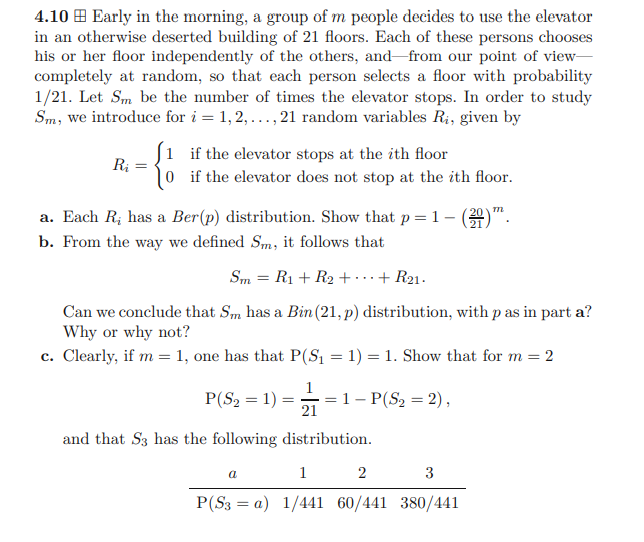
\( 4.10 \boxplus \) Early in the morning, a group of \( m \) people decides to use the elevator in an otherwise deserted building of 21 floors. Each of these persons chooses his or her floor independently of the others, and-from our point of viewcompletely at random, so that each person selects a floor with probability \( 1 / 21 \). Let \( S_{m} \) be the number of times the elevator stops. In order to study \( S_{m} \), we introduce for \( i=1,2, \ldots, 21 \) random variables \( R_{i} \), given by
\[
R_{i}=\left\{\begin{array}{ll}
1 & \text { if the elevator stops at the } i \text { th floor } \\
0 & \text { if the elevator does not stop at the } i \text { th floor. }
\end{array}\right.
\]
a. Each \( R_{i} \) has a \( \operatorname{Ber}(p) \) distribution. Show that \( p=1-\left(\frac{20}{21}\right)^{m} \).
b. From the way we defined \( S_{m} \), it follows that
\[
S_{m}=R_{1}+R_{2}+\cdots+R_{21} .
\]
Can we conclude that \( S_{m} \) has a \( \operatorname{Bin}(21, p) \) distribution, with \( p \) as in part a? Why or why not?
c. Clearly, if \( m=1 \), one has that \( \mathrm{P}\left(S_{1}=1\right)=1 \). Show that for \( m=2 \)
\[
\mathrm{P}\left(S_{2}=1\right)=\frac{1}{21}=1-\mathrm{P}\left(S_{2}=2\right),
\]
and that \( S_{3} \) has the following distribution.
\[
\begin{array}{cccc}
a & 1 & 2 & 3 \\
\hline \mathrm{P}\left(S_{3}=a\right) & 1 / 441 & 60 / 441 & 380 / 441
\end{array}
\]