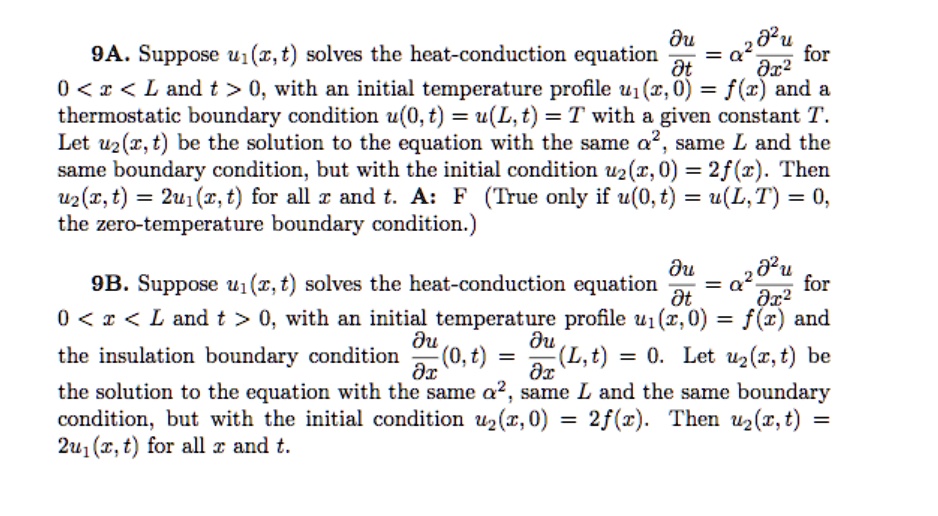
9A. Suppose $u_1(x, t)$ solves the heat-conduction equation \frac{\partial u}{\partial t} = \alpha^2 \frac{\partial^2 u}{\partial x^2} for $0 < x < L$ and $t > 0$, with an initial temperature profile $u_1(x, 0) = f(x)$ and a thermostatic boundary condition $u(0, t) = u(L, t) = T$ with a given constant $T$. Let $u_2(x, t)$ be the solution to the equation with the same $\alpha^2$, same $L$ and the same boundary condition, but with the initial condition $u_2(x, 0) = 2f(x)$. Then $u_2(x, t) = 2u_1(x, t)$ for all $x$ and $t$. A: F (True only if $u(0, t) = u(L, T) = 0$, the zero-temperature boundary condition.)
9B. Suppose $u_1(x, t)$ solves the heat-conduction equation \frac{\partial u}{\partial t} = \alpha^2 \frac{\partial^2 u}{\partial x^2} for $0 < x < L$ and $t > 0$, with an initial temperature profile $u_1(x, 0) = f(x)$ and the insulation boundary condition \frac{\partial u}{\partial x}(0, t) = \frac{\partial u}{\partial x}(L, t) = 0$. Let $u_2(x, t)$ be the solution to the equation with the same $\alpha^2$, same $L$ and the same boundary condition, but with the initial condition $u_2(x, 0) = 2f(x)$. Then $u_2(x, t) = 2u_1(x, t)$ for all $x$ and $t$.