Please help with all three questions.
7-4
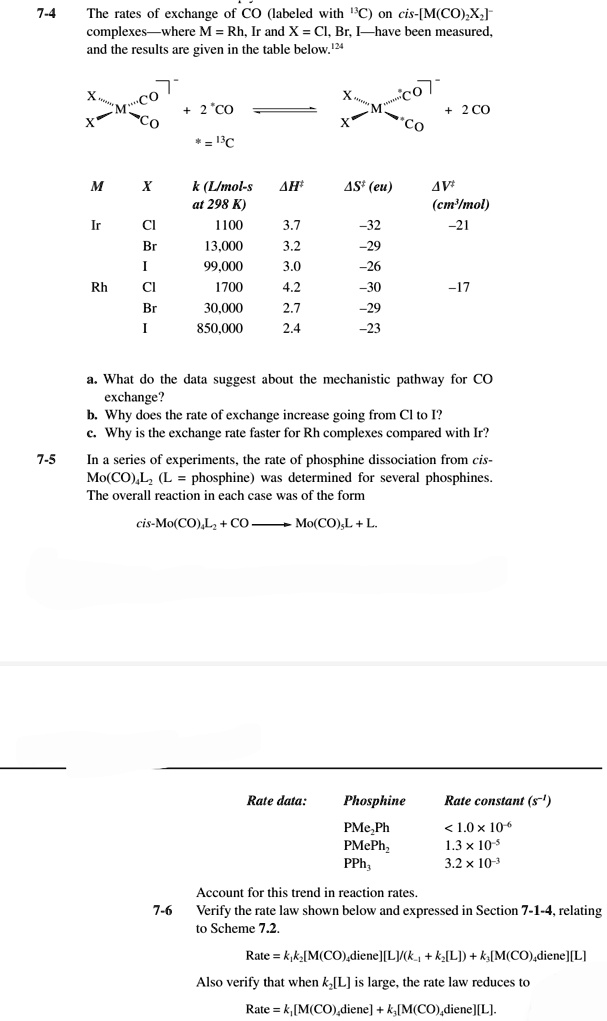
The rates of exchange of CO (labeled with 13C) on cis-[M(CO)X] complexes where M= Rh, Ir and X= Cl, Br, I have been measured, and the results are given in the table below.
M x k (L/mol-s at 298 K) S* (eu) V (cm3/mol)
Rh Cl 1100 3.7 32
Rh Br 13,000 3.2 29
Rh I 99,000 3.0 26
Ir Cl 1700 4.2 30
Ir Br 30,000 2.7 29
Ir I 850,000 2.4 23
a. What do the data suggest about the mechanistic pathway for CO exchange?
b. Why does the rate of exchange increase going from Cl to I?
c. Why is the exchange rate faster for Rh complexes compared with Ir?
7-5
In a series of experiments, the rate of phosphine dissociation from cis-Mo(CO)L (L = phosphine) was determined for several phosphines. The overall reaction in each case was of the form:
cis-Mo(CO)L + CO → Mo(CO)L + L.
Rate data:
Phosphine Rate constant (s-1)
PMe3 <1.0 10^6
PMe2Ph 1.3 10^-5
PPh3 3.2 10^3
Account for this trend in reaction rates. Verify the rate law shown below and expressed in Section 7-1-4, relating to Scheme 7.2.
7-6
Rate = kk[M(CO)diene][L]/(k+ + k[L]) + k[M(CO)diene][L]
Also verify that when k[L] is large, the rate law reduces to:
Rate = k[MCO)diene] + k[M(CO)diene][L]