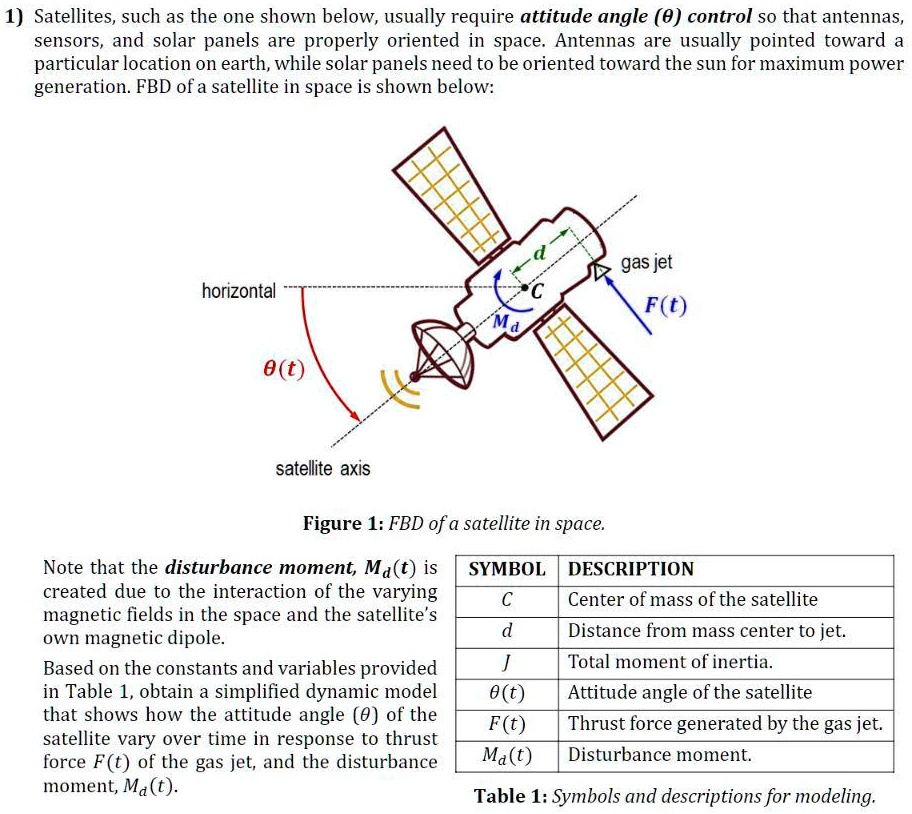
1) Satellites, such as the one shown below, usually require attitude angle (\theta) control so that antennas,
sensors, and solar panels are properly oriented in space. Antennas are usually pointed toward a
particular location on earth, while solar panels need to be oriented toward the sun for maximum power
generation. FBD of a satellite in space is shown below:
horizontal
$C$
$M_d$
gas jet
$F(t)$
$\theta(t)$
satellite axis
Figure 1: FBD of a satellite in space.
Note that the disturbance moment, $M_d(t)$ is
created due to the interaction of the varying
magnetic fields in the space and the satellite's
own magnetic dipole.
Based on the constants and variables provided
in Table 1, obtain a simplified dynamic model
that shows how the attitude angle ($\theta$) of the
satellite vary over time in response to thrust
force $F(t)$ of the gas jet, and the disturbance
moment, $M_d(t)$.
SYMBOL DESCRIPTION
C
Center of mass of the satellite
d
Distance from mass center to jet.
J
Total moment of inertia.
$\theta(t)$
Attitude angle of the satellite
$F(t)$
Thrust force generated by the gas jet.
$M_d(t)$
Disturbance moment.
Table 1: Symbols and descriptions for modeling.