Question 3.
\(\omega\)
v = 0
h
\(\omega\)
\(\frac{h}{3}\)
a. When a ball rolls without slipping on a flat plane, what is its total energy?
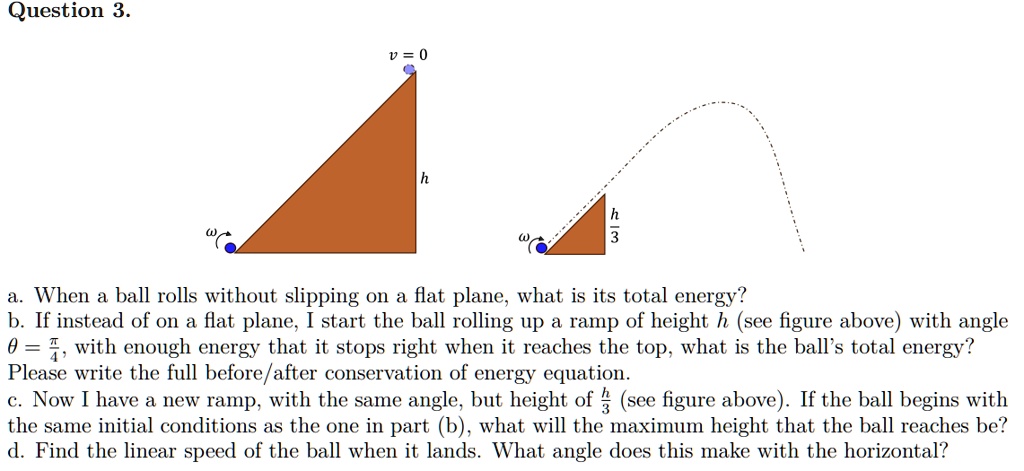
b. If instead of on a flat plane, I start the ball rolling up a ramp of height h (see figure above) with angle \(\theta = \frac{\pi}{4}\), with enough energy that it stops right when it reaches the top, what is the ball's total energy?
Please write the full before/after conservation of energy equation.
c. Now I have a new ramp, with the same angle, but height of \(\frac{h}{3}\) (see figure above). If the ball begins with
the same initial conditions as the one in part (b), what will the maximum height that the ball reaches be?
d. Find the linear speed of the ball when it lands. What angle does this make with the horizontal?