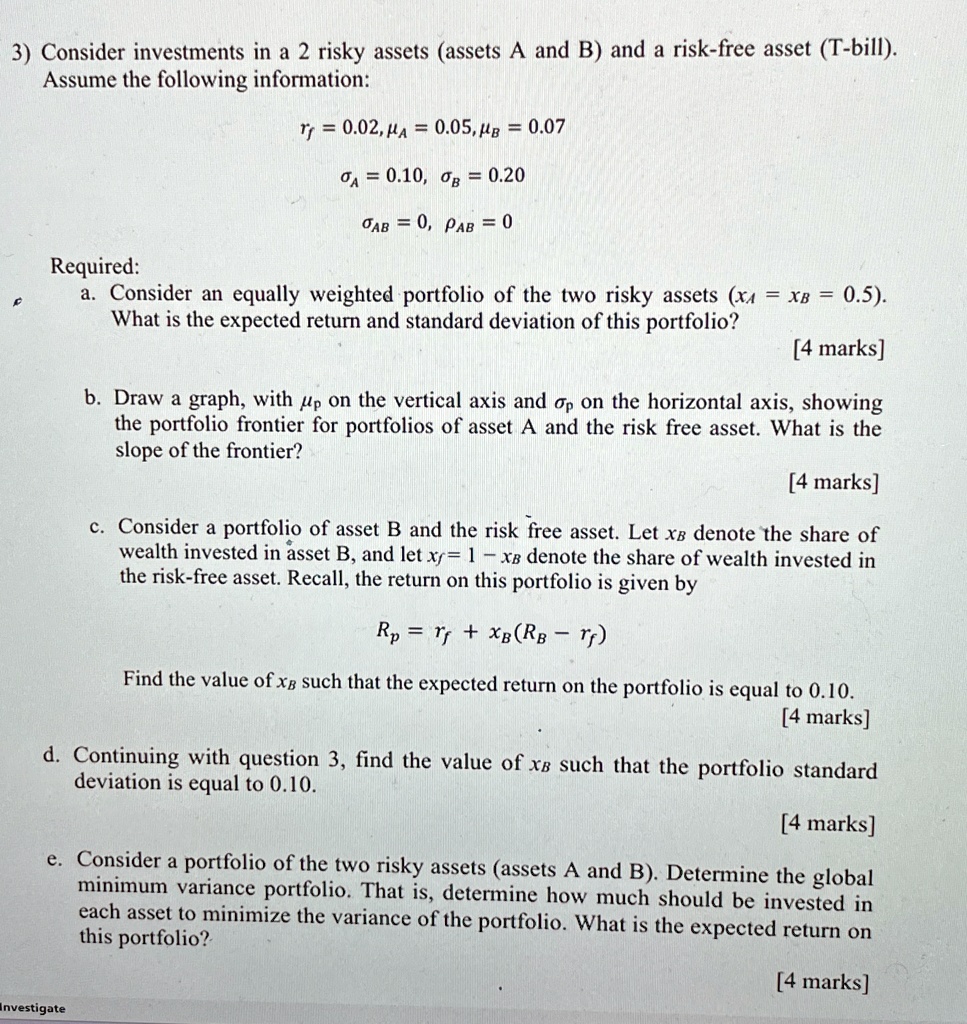
3) Consider investments in a 2 risky assets (assets A and B) and a risk-free asset (T-bill).
Assume the following information:
$r_f = 0.02$, $\mu_A = 0.05$, $\mu_B = 0.07$
$\sigma_A = 0.10$, $\sigma_B = 0.20$
$\sigma_{AB} = 0$, $\rho_{AB} = 0$
Required:
a. Consider an equally weighted portfolio of the two risky assets ($x_A = x_B = 0.5$).
What is the expected return and standard deviation of this portfolio?
[4 marks]
b. Draw a graph, with $\mu_p$ on the vertical axis and $\sigma_p$ on the horizontal axis, showing
the portfolio frontier for portfolios of asset A and the risk free asset. What is the
slope of the frontier?
[4 marks]
c. Consider a portfolio of asset B and the risk free asset. Let $x_B$ denote the share of
wealth invested in asset B, and let $x_f = 1 - x_B$ denote the share of wealth invested in
the risk-free asset. Recall, the return on this portfolio is given by
$R_p = r_f + x_B(R_B - r_f)$
Find the value of $x_B$ such that the expected return on the portfolio is equal to 0.10.
[4 marks]
d. Continuing with question 3, find the value of $x_B$ such that the portfolio standard
deviation is equal to 0.10.
[4 marks]
e. Consider a portfolio of the two risky assets (assets A and B). Determine the global
minimum variance portfolio. That is, determine how much should be invested in
each asset to minimize the variance of the portfolio. What is the expected return on
this portfolio?
[4 marks]