Questions asked
The goal of this discussion is to recognize that an observed association between two variables need not be due to a cause-and-effect relationship between the two variables. A job-training program is being reviewed. Advocates claim that because the unemployment rate in the manufacturing region the program took place in was 9% when the program began and 5% four years later, the program was effective.
What is the permutation p for which g(p)=4357621, where g is the bijection from Lemma 6.15 in the book?
What is the major difference in action between the trapezius muscles (as a whole) and the rhomboids / levator scapulae muscles (as a whole)? upwards/downwards rotation
Define or briefly explain the following relationships and concepts: 1. The relation between the BOPM and the B-S OPM 2. Implied Variance 3. Neutral Delta Strategy 4. Neutral Delta Position with Positive and Negative Gamma 5. The value of Merton's continuous dividend-adjusted BOPM for puts over Merton's continuous dividend B-S OPM for puts. 6. Why the mean is unimportant in the BOPM for a large number of sub-periods and in the B-S OPM. 7. The Black pseudo-American model for pricing American call options.
with neat sketch, explain the working of engine immobilization in a vehicle
14. Which of the following is the most basic security activity? A. Authentication B. Firewalls C. Password protection D. Auditing
Since 1960, the size of the trade sector (exports plus imports) of the United States has been: increasing as a share of the economy. relatively constant as a share of the economy. decreasing as a share of the economy. None of the above are true answers to this question.
Can you explain that thrombin cleaves peptide bonds following what amino acids?
Which adverse effect can be seen in a female client with gonadotropin deficiency and who is undergoing hormone replacement therapy? Thrombosis Hypotension Dehydration Increased thirst
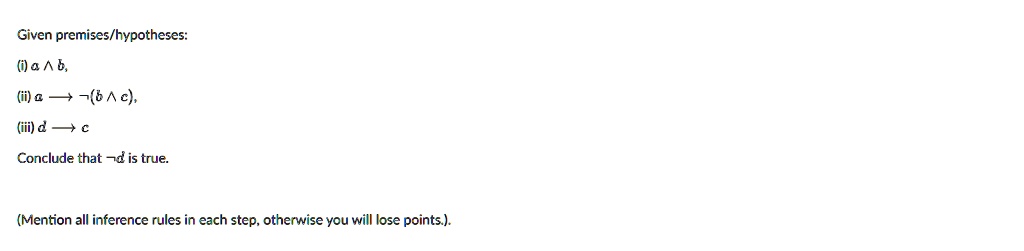
Given premises/hypotheses: (i) $a \land b$, (ii) $a \implies \neg (b \land c)$, (iii) $d \implies c$ Conclude that $\neg d$ is true. (Mention all inference rules in each step, otherwise you will lose points.).