Ace - AI Tutor
Ask Our Educators
Textbooks
My Library
Flashcards
Scribe - AI Notes
Notes & Exams
Download App
elizabeth ibarra

elizabeth i.

Divider

Questions asked

BEST MATCH

cell membrane contains channels that allow ions to cross the phospholipid bilayer 1.9 pA in 1.0ms

View Answer
divider
BEST MATCH

Contrast the effects of the three depreciation methods on annual depreciation expense. Straight-Line Units of Activity Declining-Balance Constant Amount Decreasing Amount Constant Amount

View Answer
divider
BEST MATCH

an electron moving in the direction of the +x-axis enters a magnetic field. If the electron

View Answer
divider
BEST MATCH

[-/1 Points] DETAILS MY NOTES SERCP11 17.6.P.040. PRACTICE ANOTHER ASK YOUR TEACHER A typical cellular phone consumes an average of about 1.24 W of electrical power and operates on 3.80 V. HINT (a) What average current (in A) does the phone draw from its battery? A (b) Calculate the energy (in J) stored in a fully charged battery if the phone requires charging after 8.43 hours of use. Need Help? Read It Watch It Submit Answer 10. [-/1 Points] DETAILS MY NOTES SERCP11 17.6.P.048. ASK YOUR TEACHER PRACTICE ANOTHER An office worker uses an immersion heater to warm 497 g of water in a light, covered, insulated cup from 20°C to 100°C in 3.00 minutes. The heater is a Nichrome resistance wire connected to a 120-V power supply. Assume that the wire is at 100°C throughout the 3.00-min time interval. (a) Calculate the average power required to warm the water to 100°C in 3.00 min. (The specific heat of water is 4186 J/kg °C.) W (b) Calculate the required resistance in the heating element at 100°C. ? (c) Calculate the resistance of the heating element at 20.0°C. ? (d) Derive a relationship between the diameter of the wire, the resistivity at 20.0°C, $\rho_0$, the resistance at 20.0°C, $R_0$, and the length L. (Do not substitute numerical values; use variables only.) d = (e) If L = 3.00 m, what is the diameter of the wire? mm Need Help? Read It Submit Answer

View Answer
divider
BEST MATCH

In this problem we will explore the ideas of doppler shift and beat frequency to understand how ultrasound is used to monitor fetal heart health. A. (5 points) Consider an object moving at speed $v_0$ toward an at rest source that is emitting sound waves of frequency $f_0$. Show that a reflected wave that returns to the source has a doppler shifted frequency of $f_{echo} = \left(\frac{v + v_0}{v - v_0}\right) f_0$ where $v$ is the speed of sound in the medium. B. (5 points) Rearrange your equation by factoring out the speed of sound in the medium from both the numerator and the denominator, thus creating two binomials. Using the binomial approximation, determine an expression for $f_{echo}$ up to first order. The binomial approximation to first order is given by if $x << 1$. $(1 + x)^n \approx 1 + nx$ C. (5 points) Suppose the objects speed is much less than the wave speed $v_0 << v$. When this happens, the frequency $f_{echo} \approx f_0$. The microphone that is sensitive to these frequencies will detect a beat frequency if it listens to $f_{echo}$ and $f_0$ simultaneously. Use the binomial approximation to show that (up to first order) the beat frequency is $f_{beat} = (2v_0/v) f_0$ D. (5 points) The reflection from the surface of a fetus's beating heart combines with the 2.40 MHz ultrasound waves to produce a beat frequency of 65 Hz. The speed of ultrasound waves within the human body is 1540 m/s. What is the maximum speed of the surface of the fetus heart? E. (5 points) Suppose the surface of the heart moves with simple harmonic motion at 90 beats/min. What is the amplitude in mm of the heartbeat? Does your answer seem reasonable? What are the typical dimensions of a fetus heart? 2

View Answer
divider
BEST MATCH

A female Drak that is homozygous recessive for red eyes and homozygous dominant for purple scales and fire-spitting is crossed to a male Drak that is heterozygous for black eyes (B), purple scales (Q), and fire-spitting (F). Calculate the distance between the F and B loci (rounded to the tenths), including the units. Chromosome B Q F 12 B Q f 43 B q F 78 B q f 554 b Q F 478 b Q f 65 b q F 52 b q f 9

View Answer
divider
BEST MATCH

Assuming a welded rail line, 1km long, that is unconstrained except at the ends. The rail has a cross sectional profile as given. If the rail was installed at a temperature of 20°C, at what temperature would the rail buckle? How much pre-stress would need to be applied to the rail in order to prevent buckling up to a maximum operating temperature of 40°C? C Y X X H A Y P Rail profile Equivalent Section weight Rail height Head width Web thickness Foot width profile name kg/m mm (H) mm (Q mm (A) mm (P) 46E1 SBBI 46.17 145.00 65.00 14.00 125.00 Moment of inertia, Ixx cm² 1641.10 Moment of inertia, lyy cm³ 298.20

View Answer
divider
BEST MATCH

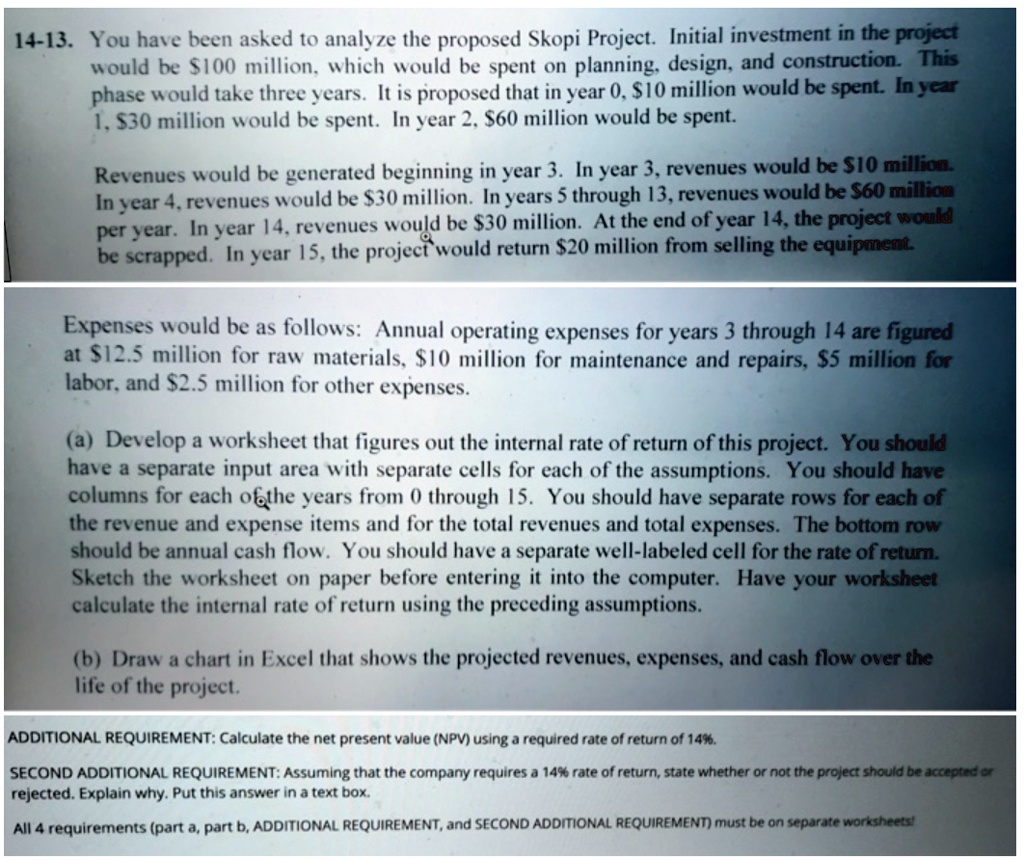
Phase would take three years. It is proposed that in year 0, $10 million would be spent. In year 1, $30 million would be spent. In year 2, $60 million would be spent. Revenues would be generated beginning in year 3. In year 3, revenues would be $10 million. In year 4, revenues would be $30 million. In years 5 through 13, revenues would be $60 million per year. In year 14, revenues would be $30 million. At the end of year 14, the project would be scrapped. In year 15, the project would return $20 million from selling the equipment. Expenses would be as follows: Annual operating expenses for years 3 through 14 are figured at $12.5 million for raw materials, $10 million for maintenance and repairs, $5 million for labor, and $2.5 million for other expenses. a. Develop a worksheet that figures out the internal rate of return of this project. You should have a separate input area with separate cells for each of the assumptions. You should have columns for each of the years from 0 through 15. You should have separate rows for each of the revenue and expense items and for the total revenues and total expenses. The bottom row should be annual cash flow. You should have a separate well-labeled cell for the rate of return. Sketch the worksheet on paper before entering it into the computer. Have your worksheet calculate the internal rate of return using the preceding assumptions. b. Draw a chart in Excel that shows the projected revenues, expenses, and cash flow over the life of the project. ADDITIONAL REQUIREMENT: Calculate the net present value (NPV) using a required rate of return of 14%. SECOND ADDITIONAL REQUIREMENT: Assuming that the company requires a 14% rate of return, state whether or not the project should be accepted or rejected. Explain why. Put this answer in a text box. All 4 requirements (part a, part b, ADDITIONAL REQUIREMENT, and SECOND ADDITIONAL REQUIREMENT) must be on separate worksheets.
View Answer
divider
BEST MATCH

$y = 2x^2 + 3$

View Answer
divider
BEST MATCH

La sombra de un edificio a cierta hora del día mide 14 metros. ¿Cuál es la altura del edificio sabiendo que el ángulo que forman los rayos del sol con este es de 48°?

View Answer
divider