Please do each question in detail. Question 2 (45 points)
Suppose that you've been hired to work as an analyst at a sports consultancy firm. Your task
is to evaluate the effectiveness of players on the client's team. For each of the players on the
team, you have data containing the number of goals they scored last season, the number of
minutes in the season they spent on the field, but also the number of times they got injured
during the season, and, lastly, whether the player was on a trial contract (players on a trial
contract may be dropped by the team coach at the end of the season if the coach is not
satisfied with their performance, while regular players stay on until their contracts run out).
Using these data, suppose that you estimate the following regression model using OLS:
Y_(i)=�eta _(0)+�eta _(1)x_(i1)+�eta _(2)x_(i2)+alpha _(1)D_(i)+u_(i),
where Y_(i) are season goals for player i,x_(i1) - their field time (in minutes), x_(i2) - their season
injuries and D_(i) is the player contract dummy such that
D_(i)={(1 if the player i is on a trial contract, and ),(0 if otherwise. ):}
Suppose that you get the following regression estimates:
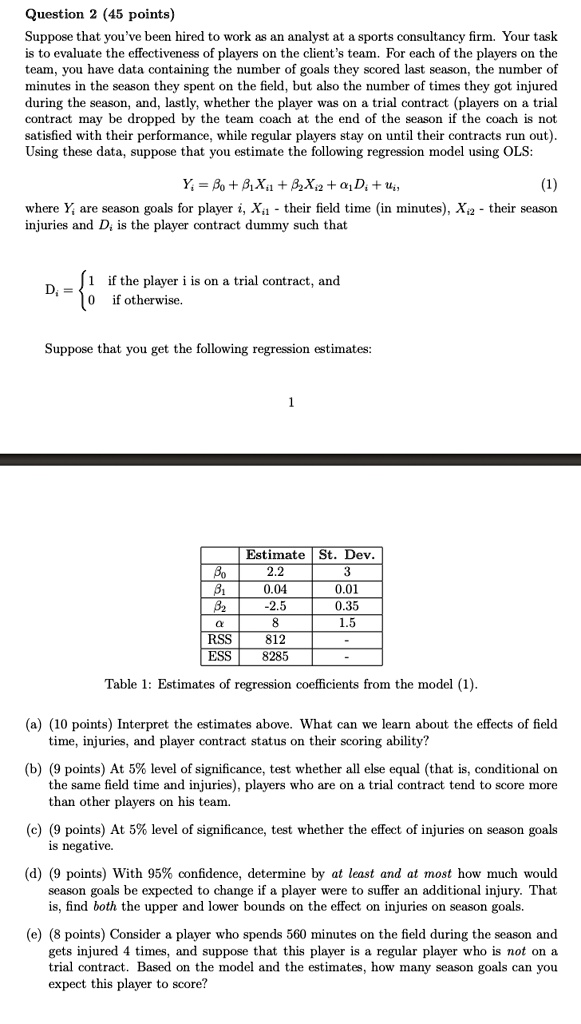
Table 1: Estimates of regression coefficients from the model (1).
(a) (10 points) Interpret the estimates above. What can we learn about the effects of field
time, injuries, and player contract status on their scoring ability?
(b) (9 points) At 5% level of significance, test whether all else equal (that is, conditional on
the same field time and injuries), players who are on a trial contract tend to score more
than other players on his team.
(c) (9 points) At 5% level of significance, test whether the effect of injuries on season goals
is negative.
(d) (9 points) With 95% confidence, determine by at least and at most how much would
season goals be expected to change if a player were to suffer an additional injury. That
is, find both the upper and lower bounds on the effect on injuries on season goals.
(e) (8 points) Consider a player who spends 560 minutes on the field during the season and
gets injured 4 times, and suppose that this player is a regular player who is not on a
trial contract. Based on the model and the estimates, how many season goals can you
expect this player to score?
Question 2 (45 points)
Suppose that you've been hired to work as an analyst at a sports consultancy firm. Your task is to evaluate the effectiveness of players on the client's team. For each of the players on the team, you have data containing the number of goals they scored last season, the number of minutes in the season they spent on the field, but also the number of times they got injured during the season, and, lastly, whether the player was on a trial contract (players on a trial contract may be dropped by the team coach at the end of the season if the coach is not satisfied with their performance, while regular players stay on until their contracts run out) Using these data, suppose that you estimate the following regression model using OLS:
Y=+X1+X2+D;+
(1) where Y; are season goals for player i, X; - their field time (in minutes), X;2 - their season injuries and D; is the player contract dummy such that
(1if the player i is on a trial contract, and D;= oif otherwise.
Suppose that you get the following regression estimates:
1
Estimate St.Dev. o 2.2 3 1 0.04 0.01 2 -2.5 0.35 a 8 1.5 RSS 812 ESS 8285
Table 1: Estimates of regression coefficients from the model (1)
(a) (10 points Interpret the estimates above. What can we learn about the effects of field time, injuries, and player contract status on their scoring ability?
(b) (9 points) At 5% level of significance, test whether all else equal (that is, conditional on the same field time and injuries), players who are on a trial contract tend to score more than other players on his team.
(c) (9 points) At 5% level of significance, test whether the effect of injuries on season goals is negative.
d) (9 points) With 95% confidence, determine by at least and at most how much would season goals be expected to change if a player were to suffer an additional injury. That is, find both the upper and lower bounds on the effect on injuries on season goals.
e) (8 points) Consider a player who spends 560 minutes on the field during the season and gets injured 4 times, and suppose that this player is a regular player who is not on a trial contract. Based on the model and the estimates, how many season goals can you expect this player to score?