Questions asked
What is a key factor driving the rapid spread of IT advancements globally? (4 Points) A) Increased reliance on personal computers over smartphones B) The limited use of the World Wide Web for global transactions C) The lack of skilled workers available for technology firms D) The reduction in the unit cost of computing power and transmissions
A 1954 study of children in California found that heights of 9-year-old kids have a mean of 135 centimeters (cm) and a standard deviation of 5.6cm, while weights of 9-year-old kids have a mean of 31.6 kilograms (kg) and a standard deviation of 5.8kg. The correlation between heights and weights is 0.73. Assume that heights and weights follow a bivariate normal distribution.
Think of a role model you believe embodies the qualities vital to being ethical. Although the person does not have to be famous, it must be human. Say who this person is and why you look up to him/her for ethical guidance. Answer the question as follows: 5.1 Who is the role model 5.2 name the qualities 5.2.1 Reasons for the qualities
Question 1 Viruses carry all proteins and nucleic acids that they need for replication. They do not need to use any Host machinery. True False 1 pts
The Egalitarian theory of justice denies that health care is a human right. Group of answer choices True False
Part A A 211-kg projectile, fired with a speed of 147 m/s at a 59.0° angle, breaks into three pieces of equal mass at the highest point of its arc (where its velocity is horizontal). Two of the fragments move with the same speed right after the explosion as the entire projectile had just before the explosion, one of these moves vertically downward and the other horizontally. Determine the magnitude of the velocity of the third fragment immediately after the explosion. Determine the direction of the velocity of the third fragment immediately after the explosion. Determine the energy released in the explosion.
Q1:Find the center of mass bounded byy=|x|and y=1if =3x+1
Which light bulb is brighter? ? ?) 7 ? B) the same ? C) 6 ? D) 4 ? 4? 4? 6? 7?
3. An long, thin plate is suspended in a still fluid. It is infinitely large in the x-and y-directions, and infinitely thin in the z-direction, and sits in the plane defined by z = 0. At time t = 0, the plate begins to move with a constant velocity in the x-direction, given by $U_0 \hat{i}$. We would like to know what the velocity profile looks like above the plate (for positive values of z) as it develops in time. (a) What are the appropriate assumptions to make for this flow? Justify them. (b) Write out the continuity equation in Cartesian coordinates and simplify it using your assumptions from (a). What does this tell you about w? (c) Write out the x-component of the Navier-Stokes equation and simplify it as much as you can, using your assumptions from (a). Justify each term you strike out and write out the final (simplified) equation. Do not attempt to solve it. (d) Your equation from (d) should be second-order in space and first-order in time and contain only u (not v or w). This means we need two boundary conditions and one intial condition for u. What are they?
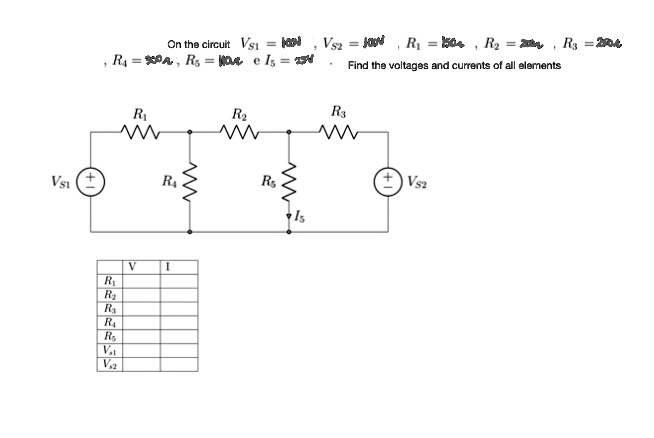
On the circuit $V_{s1} = 100V$, $V_{s2} = 100V$, $R_1 = 150\Omega$, $R_2 = 200\Omega$, $R_3 = 200\Omega$, $R_4 = 350\Omega$, $R_5 = 100\Omega$, $I_s = 25V$. Find the voltages and currents of all elements