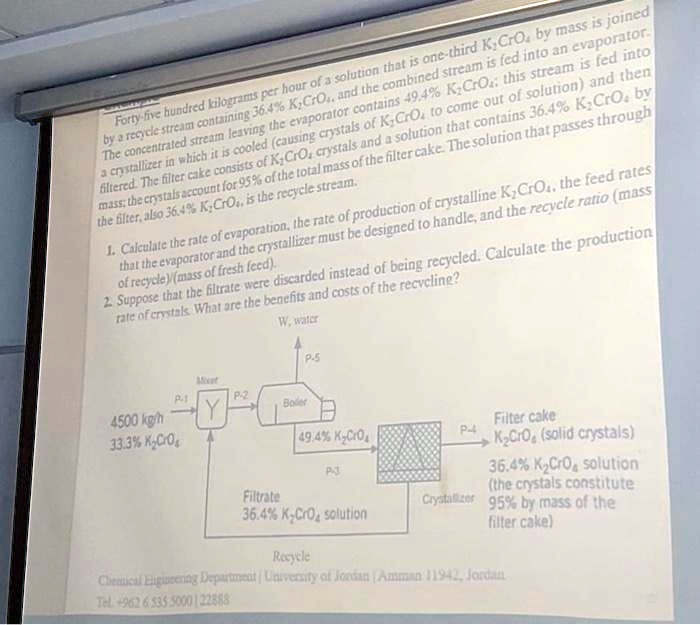
Forty-five hundred kilograms per hour of a solution that is one-third $K_2CrO_4$ by mass is joined
by a recycle stream containing 36.4% $K_2CrO_4$, and the combined stream is fed into an evaporator.
The concentrated stream leaving the evaporator contains 49.4% $K_2CrO_4$; this stream is fed into
a crystallizer in which it is cooled (causing crystals of $K_2CrO_4$ to come out of solution) and then
filtered. The filter cake consists of $K_2CrO_4$ crystals and a solution that contains 36.4% $K_2CrO_4$ by
mass; the crystals account for 95% of the total mass of the filter cake. The solution that passes through
the filter, also 36.4% $K_2CrO_4$, is the recycle stream.
1. Calculate the rate of evaporation, the rate of production of crystalline $K_2CrO_4$, the feed rates
that the evaporator and the crystallizer must be designed to handle, and the recycle ratio (mass
of recycle)/(mass of fresh feed).
2. Suppose that the filtrate were discarded instead of being recycled. Calculate the production
rate of crystals. What are the benefits and costs of the recycling?