Price of wheat = 1w + 2r
Price of cloth = 2w + 1r
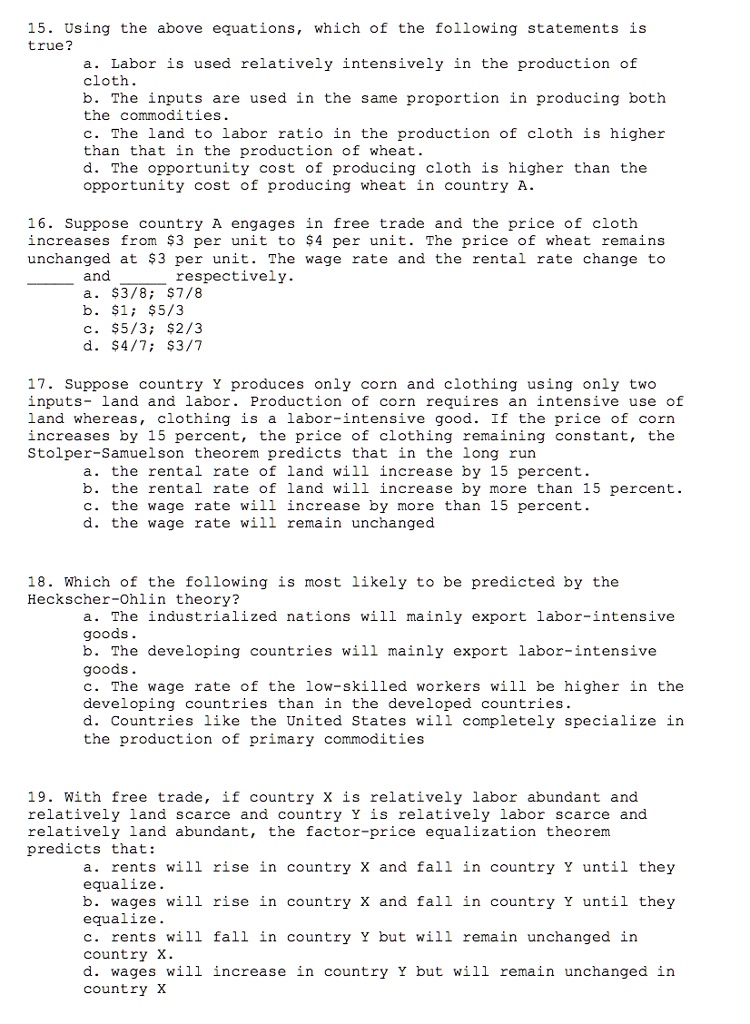
i5. Using the above equations, which of the following statements is true?
a. Labor is used relatively intensively in the production of cloth.
b. The inputs are used in the same proportion in producing both commodities.
c. The land to labor ratio in the production of cloth is higher than that in the production of wheat.
d. The opportunity cost of producing cloth is higher than the opportunity cost of producing wheat in country A.
i6. Suppose country A engages in free trade and the price of cloth remains unchanged at $3 per unit. The wage rate and the rental rate change to $3/8 and $7/8 respectively.
a. $3/8; $7/8
b. $1; $5/3
c. $5/3; $2/3
d. $4/7; $3/7
i7. Suppose country Y produces only corn and clothing using only two inputs - land and labor. Production of corn requires an intensive use of land whereas clothing is a labor-intensive good. If the price of corn increases by 15 percent, the price of clothing remaining constant, the Stolper-Samuelson theorem predicts that in the long run
a. the rental rate of land will increase by 15 percent.
b. the rental rate of land will increase by more than 15 percent.
c. the wage rate will increase by more than 15 percent.
d. the wage rate will remain unchanged.
Heckscher-Ohlin theory?
a. The industrialized nations will mainly export labor-intensive goods.
b. The developing countries will mainly export labor-intensive goods.
c. The wage rate of the low-skilled workers will be higher in the developing countries than in the developed countries.
d. Countries like the United States will completely specialize in the production of primary commodities.
i9. With free trade, if country X is relatively labor abundant and relatively land scarce and country Y is relatively labor scarce and relatively land abundant, the factor-price equalization theorem predicts that:
a. rents will rise in country X and fall in country Y until they equalize.
b. wages will rise in country X and fall in country Y until they equalize.
c. rents will fall in country Y but will remain unchanged in country X.
d. wages will increase in country Y but will remain unchanged in country X.