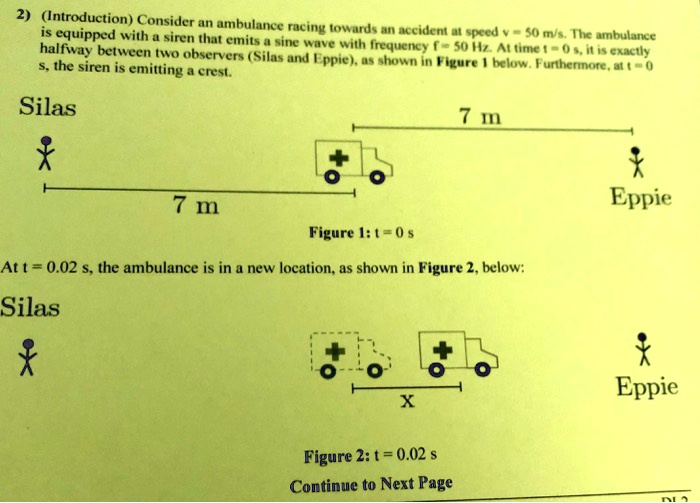
2) (Introduction) Consider an ambulance racing towards an accident at speed $v = 50 \text{ m/s}$. The ambulance is equipped with a siren that emits a sine wave with frequency $f = 50 \text{ Hz}$. At time $t = 0 \text{ s}$, it is exactly halfway between two observers (Silas and Eppie), as shown in Figure 1 below. Furthermore, at $t = 0 \text{ s}$, the siren is emitting a crest.
Silas
\begin{tikzpicture}
\draw (0,0) -- (7,0);
\draw (0,0) -- (0,0.5);
\draw (7,0) -- (7,0.5);
\node at (0,0) {\tiny{$�ullet$}};
\node at (3.5,0.5) {\Large{+}};
\node at (7,0) {\tiny{$�ullet$}};
\node at (3.5, -0.5) {Ambulance};
\node at (0, 0.7) {Silas};
\node at (7, 0.7) {Eppie};
\node at (3.5, 0) {7 m};
\end{tikzpicture}
7 m
Figure 1: $t = 0 \text{ s}$
At $t = 0.02 \text{ s}$, the ambulance is in a new location, as shown in Figure 2, below:
Silas
\begin{tikzpicture}
\draw (0,0) -- (7,0);
\draw (0,0) -- (0,0.5);
\draw (7,0) -- (7,0.5);
\node at (0,0) {\tiny{$�ullet$}};
\node at (1.75,0.5) {\Large{+}};
\node at (4.25,0.5) {\Large{+}};
\node at (7,0) {\tiny{$�ullet$}};
\node at (0, 0.7) {Silas};
\node at (7, 0.7) {Eppie};
\node at (3.5, 0) {X};
\end{tikzpicture}
Eppie
Figure 2: $t = 0.02 \text{ s}$