Ace - AI Tutor
Ask Our Educators
Textbooks
My Library
Flashcards
Scribe - AI Notes
Notes & Exams
Download App
emilia lawrence

emilia l.

Divider

Questions asked

BEST MATCH

the child's physical, cognitive, social, and emotional skill sets which, in turn, creates the pot further growth and development. a. True b. False 7. Child development is different now than it was 200 years ago. This difference is due to: a. Biology (genetics) b. Cultural and social forces c. In vitro fertilization d. Global warming 8. Pre-formationism is defined as the belief that children possess: a. A genetic predisposition for stature (height and weight) b. Innate artistic and musical talents c. Adult-like capabilities d. The ability to learn any language that is taught prior to age 2 9. Although a child's genetics are inherited, their culture is not. a. True b. False 10. The degree to which human development is open to change is called: a. Imprinting b. The all-or-nothing period c. Plasticity d. All of the above 11. Imprinting in ducks and geese is an example of: a. a critical period of development b. how they learn to navigate c. how they learn to fly d. how they learn to swim 12. In children, acquiring language is subject to a sensitive period of development. In cases, oral speech will fail to emerge if the child is not talking by this age: a. age 4 b. age 5 c. age 6 d. age 7

View Answer
divider
BEST MATCH

Write 5 (total, 1 for each) multiple choice questions covering all of the COGNITIVE taxonomic levels (1 point). Label the test item with its taxonomic level (1 point) and correct answer (1 point) for this objective, Given an example of antigen identification using the indirect antiglobulin method, evaluate the results of the controls and patient’s tests

View Answer
divider
BEST MATCH

Why is it a myth that "love is a random force" (Baucham, 2007, p. 55)? Love is a willful ace. The Hebrew meaning of heart - lebab - that means "inner man, mind, or will". Love resides in both the heart and the mind. All of the above None of the above.

View Answer
divider
BEST MATCH

MATLAB: Write a function called GenMatBorder that takes an array of numbers and produces an array called OutMat, which replaces the top row, bottom row, left column, and right column of the input array with zeros. Use logical indexing.

View Answer
divider
BEST MATCH

5. Find the Taylor series for $f(x)$ centered at the given value of $a$, and find the radius of convergence. [Assume $f$ has a series expansion at $a$. Don't show $R_n(x)\rightarrow 0$.] a) $f(x) = x^5 + 2x^3 + x$, $a = 2$ b) $f(x) = 1/x$, $a = -3$ c) $f(x) = \frac{1}{\sqrt{x}}$, $a = 1$ Hint: $1 \cdot 3 \cdot 5 \cdots (2n + 1) = \frac{1 \cdot 2 \cdot 3 \cdots (2n + 1)}{2 \cdot 4 \cdot 6 \cdots (2n)} = \frac{(2n + 1)!}{2^n n!}$

View Answer
divider
BEST MATCH

Find the first and second partial derivatives of the function f(x, y) = (8 + 7xy)e^(-5x^2-8y^2) f_x = (7y)(e^(-5x^2-8y^2)) + ((8+7xy)(e^(-5x^2-8y^2))(-10x)) f_y = (7x)(e^(-5x^2-8y^2)) + ((8+7xy)(e^(-5x^2-8y^2))(-16y)) f_xx = (7y)(e^(-5x^2-8y^2))(-10x) + (7x)(10x)(e^(-5x^2-8y^2)) + (8+7xy)(e^(-5x^2-8y^2))(-10x)^2 f_yy = (7y)(e^(-5x^2-8y^2))(-16y) + (7x)(e^(-5x^2-8y^2)) + (8+7xy)(e^(-5x^2-8y^2))(-16y)^2

View Answer
divider
BEST MATCH

> sh -c javac -classpath :target/dependency/* -d . $(find -type f -name '*.java') ./HauntedHouse.java:134: error: cannot find symbol ibleMoves() ); "You can go " + currentNode.getPoss symbol: method getPossibleMoves() location: variable currentNode of type Node

View Answer
divider
BEST MATCH

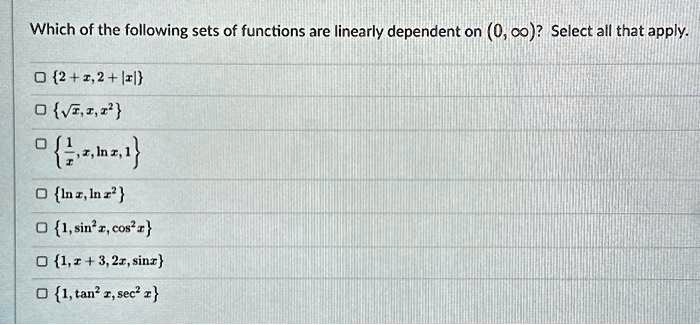
Which of the following sets of functions are linearly dependent on (0, ?)? Select all that apply. {2 + \textit{x}, 2 + |\textit{x}|} {\sqrt{\textit{x}}, \textit{x}, \textit{x}^2} {\{\frac{1}{\textit{x}}, \textit{x}, \ln \textit{x}, 1\}} {\{\ln \textit{x}, \ln \textit{x}^2\}} {\{1, \sin^2 \textit{x}, \cos^2 \textit{x}\}} {\{1, \textit{x} + 3, 2\textit{x}, \sin \textit{x}\}} {\{1, \tan^2 \textit{x}, \sec^2 \textit{x}\}
View Answer
divider
BEST MATCH

10. (5 points) Consider two p.d.f.'s $f_0(x)$ and $f_1(x)$ that are defined as follows: $f_0(x) = \begin{cases} 2x, & \text{for } 0 \le x \le 1, \\ 0, & \text{otherwise,} \end{cases}$ and $f_1(x) = \begin{cases} 1, & \text{for } 0 \le x \le 1, \\ 0, & \text{otherwise.} \end{cases}$ Suppose that a single observation $X$ is taken from a distribution for which the p.d.f. $f(x)$ is either $f_0(x)$ or $f_1(x)$, and the following simple hypotheses are to be tested: $H_0: f(x) = f_0(x)$, $H_1: f(x) = f_1(x)$. (a) Describe a test procedure (specifying how to reject $H_0$) for which $\alpha(\delta) \le 0.01$ and $\beta(\delta)$ is a minimum. Reject $H_0$ if (b) Determine the minimum value of $\beta(\delta)$ attained by the procedure in Part (a).

View Answer
divider
BEST MATCH

1. A 3000 kg mass was moved up by an external force at a constant speed to a height of 200 m in 20 s. What was average power exerted by the external force in lifting up the object? 2. A 5 kg object was moving on a smooth surface at a speed of 5 m/s on a level surface. An external force of 100 N acts on the object over a distance of 10 m, at an angle of 60° above the horizontal. What is the new speed of the object? 3. A 10 kg object was positioned at a height of 1.0 m above the surface of a relaxed spring. When the object was released from rest it compressed the spring by 10 cm, before coming to rest. What is the spring constant? 4. An inclined smooth slide is 6 m long that makes an angle of 30° above the horizontal. A 100 kg person slides down. What was his speed when he reached the ground? 5. Earth and moon are separated by a distance of 3.82x10$^m$. The mass of earth is 5.98x10$^{24}$ kg. kg and that of moon is 7.36x10$^{22}$ kg. Where is the center of mass located for the earth-moon system?

View Answer
divider