Ace - AI Tutor
Ask Our Educators
Textbooks
My Library
Flashcards
Scribe - AI Notes
Notes & Exams
Download App
emilia martinez

emilia m.

Divider

Questions asked

BEST MATCH

Which of the following is not involved with spinal gating of pain signals? Multiple Choice Nociceptors Second-order neurons The reticulospinal tract

View Answer
divider
BEST MATCH

The dissociation constant ($K_I$ in units of nM) of the inhibitor is: 12.7177

View Answer
divider
BEST MATCH

A mutation that modifies a normal codon to a stop codon is called a _________ mutation. Group of answer choices silent point back nonsense missense

View Answer
divider
BEST MATCH

WHICH OF THE FOLLOWING STATEMENTS SUMMARIZES THE DIFFERENCE BETWEEN DNA AND RNA

View Answer
divider
BEST MATCH

A study measure the health-related quality of life (HRQOL) of 126 persons with a disability or illness. The researchers compared the HRQOL of 50 persons who currently lived wiht a service dog with 76 persons who were on a waiting list to receive one. The researchers concluded that those who lived with a service dog had better HRQOL than those who did not. Is this an observational study or an experiment? Is it a sample survey? If is is an experiment, what is the intervention?

View Answer
divider
BEST MATCH

Using the data from Digital Appendix 3, determine if reaction time is different between males and females, between athletes and nonathletes, and if there is an interaction between gender and athletic participation.

View Answer
divider
BEST MATCH

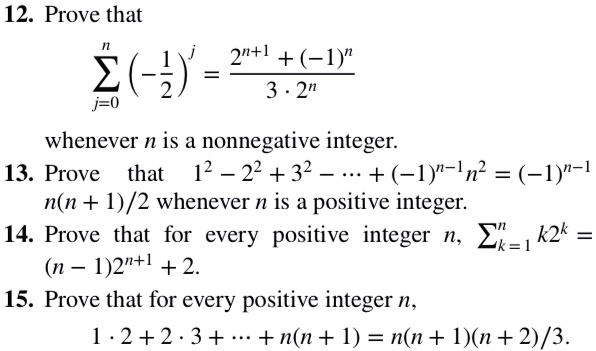
Prove that sum_(j=0)^n (-(1)/(2))^(j)=(2^(n+1)+(-1)^(n))/(3*2^(n)) whenever n is a nonnegative integer. 13. Prove that 1^(2)-2^(2)+3^(2)-cdots+(-1)^(n-1)n^(2)=(-1)^(n-1) n(n+1)/(2) whenever n is a positive integer. 14. Prove that for every positive integer n,sum_(k=1)^n k2^(k)= (n-1)2^(n+1)+2. 15. Prove that for every positive integer n, 1*2+2*3+cdots+n(n+1)=n(n+1)(n+2)/(3.) 12. Prove that 2(-) 2n+1 + (-1)n 3.2n whenever n is a nonnegative integer 13. Prove that12 -22 +32 - ...+(-1)n-1n2 =(-1)n-1 n(n + 1)/2 whenever n is a positive integer. 14. Prove that for every positive integer n, E= k2k = (n - 1)2n+1 + 2. 15. Prove that for every positive integer n, 12+23+...+n(n+1=nn+1n+2/3
View Answer
divider
BEST MATCH

16. (a) Suggest appropriate reagent(s) for the following transformations: (i) \( \text{MeO}_{2} \text{C} \) \( \begin{array}{c} \text{O} \\ \text{C} \end{array} \) \( \text{CO}_{2} \text{H} \) \( \longrightarrow \) \( \text{HO} \) \( \begin{array}{c} \text{O} \\ \text{C} \end{array} \) \( \text{CO}_{2} \text{H} \) (ii) \( \text{MeO}_{2} \text{C} \) \( \begin{array}{c} \text{O} \\ \text{C} \end{array} \) \( \text{CO}_{2} \text{H} \) \( \longrightarrow \) \( \text{MeO}_{2} \text{C} \) \( \begin{array}{c} \text{O} \\ \text{C} \end{array} \) \( \text{OH} \) Which type of selective reaction is typified by the above transformations? (b) Complete the following reaction using plausible reaction mechanism to justify your answer. \( \text{NaOH} \)

View Answer
divider
BEST MATCH

14. Determine the inverse Laplace of the following function and use the initial and final value theorem to find the initial and final value of the following transfer functions.\\ i) $F(s) = \frac{7s^2 + 63s + 134}{(s+3)(s+4)(s+5)}$\\ii) $F(s) = \frac{4s^2 + 7s + 1}{s(s+1)^2}$\\iii) $F(s) = \frac{40}{(s^2 + 4s + 5)^2}$

View Answer
divider
BEST MATCH

Consider the database transactions listed below. T1 a = read (x) w(y,a+2) commit T2 b = read (y) w(x,b+1) commit T3 c = read(z) d = read (y) e = read (x) commit Show a sample concurrent execution of the transactions T1, T2, and T3 that is controlled by Serialization Graph Testing scheduler and such that the execution triggers abort of one of the transactions.

View Answer
divider